How to Handle Payments for Martial Arts Academies
Learn best practices to handle payments securely and efficiently in your martial arts academy. Discover automation, compliance, and fraud prevention.
- By
- RankPill
- Published
- August 1, 2026
- Reading time
- 12 min read
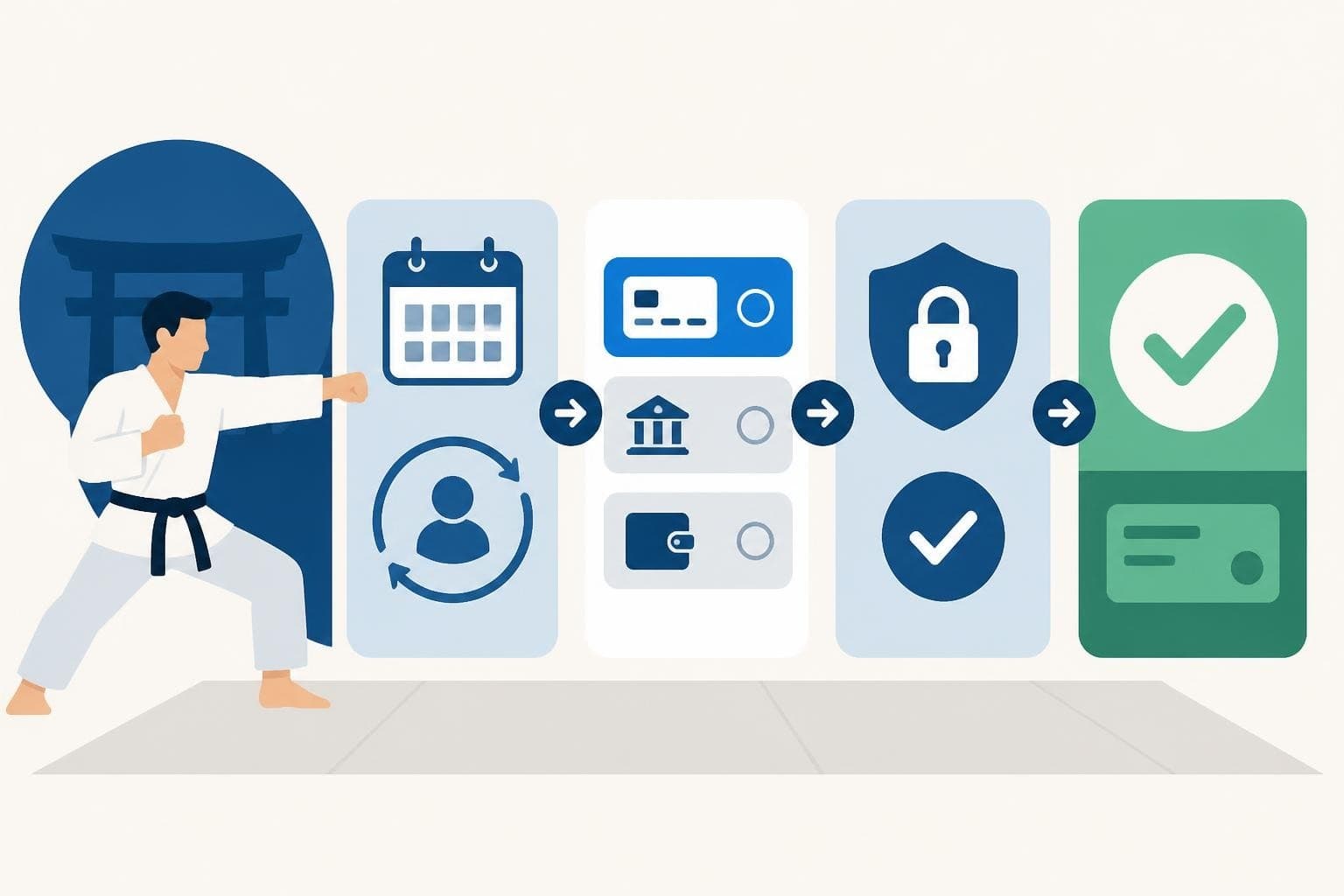
Running a martial arts academy requires more than just exceptional instruction and student engagement. The financial backbone of your operation depends on how effectively you handle payments from members, manage billing cycles, and ensure every transaction is secure and compliant. Whether you're processing monthly memberships, drop-in class fees, or merchandise purchases, implementing robust payment systems protects both your revenue stream and your students' financial information. Modern payment processing has evolved far beyond simple cash transactions, and academy owners must navigate complex requirements while maintaining a seamless experience for their members.
Understanding Payment Processing Requirements for Martial Arts Academies
When you handle payments in a martial arts setting, you're managing recurring memberships that require automated billing systems. Most academies operate on monthly or annual membership models, creating unique challenges compared to one-time transaction businesses.
Your payment infrastructure must accommodate:
- Recurring billing for monthly memberships
- Family plans with multiple students
- Contract-based training programs
- Drop-in class fees and punch cards
- Pro shop merchandise and equipment sales
- Private lesson fees and specialty workshops
The complexity increases when you consider payment method diversity. Students expect to pay using credit cards, debit cards, ACH transfers, digital wallets, and occasionally cash. Each payment method carries distinct processing fees, settlement timelines, and security requirements.
Compliance and Security Standards
Payment security isn't optional when you handle payments for your academy. The PCI Security Standards Council establishes mandatory requirements for any business that processes, stores, or transmits cardholder data. Compliance protects your business from devastating data breaches that could cost hundreds of thousands of dollars in fines and remediation.
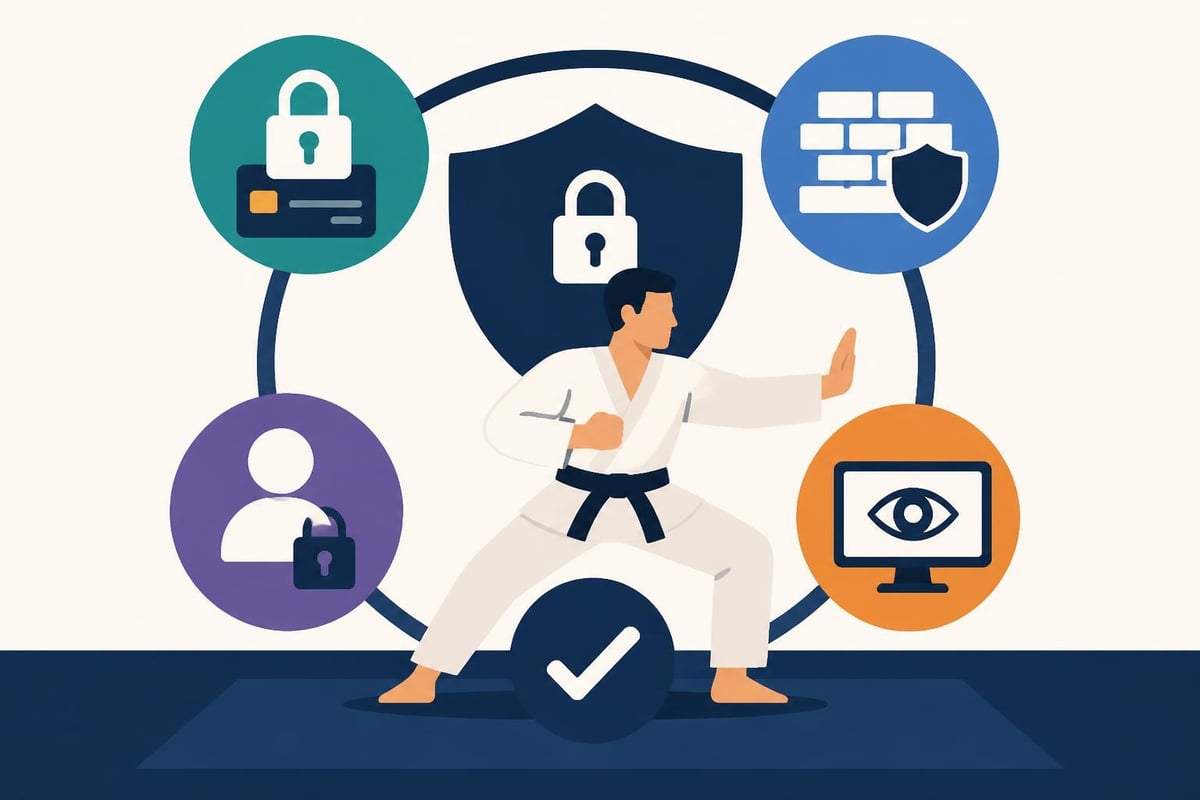
Key compliance elements include:
- Encryption of cardholder data during transmission and storage
- Secure network infrastructure with firewalls and anti-malware systems
- Restricted access to payment information on a need-to-know basis
- Regular security audits and vulnerability assessments
- Incident response plans for potential breaches
According to American Express merchant guidelines, maintaining PCI compliance builds customer trust and reduces liability. For martial arts academies, this trust is essential since you're often handling payment information for entire families over multi-year relationships.
Automation and Recurring Payment Management
Manual payment collection drains valuable time that should be spent on instruction and student development. When you automate how you handle payments, you create predictable cash flow while reducing administrative burden.
Automated billing systems process recurring charges on scheduled dates, send payment reminders before due dates, and handle failed payment recovery. This automation proves particularly valuable for martial arts academies where revenue optimization depends on consistent membership billing.
Failed Payment Recovery Strategies
Failed payments represent one of the largest revenue leakage points for membership-based businesses. Credit cards expire, bank accounts change, and insufficient funds cause declined transactions. Your payment system needs intelligent retry logic to recover these failed charges.
| Recovery Strategy | Implementation Timeline | Success Rate |
|---|---|---|
| Immediate retry | Within 1 hour | 15-20% |
| Second attempt | 3 days later | 25-30% |
| Third attempt | 7 days later | 10-15% |
| Member notification | After first failure | 40-50% |
| Account suspension | After 14 days | 60-70% |
The most effective approach combines automated retries with member communication. Send automated emails when payments fail, providing links to update payment information directly. Many students simply need to update an expired card, but they won't know to do so without notification.
Selecting the Right Payment Processor
Not all payment processors serve martial arts academies equally well. Your processor selection impacts transaction fees, funding speed, and available features. Traditional merchant account providers offer lower per-transaction fees but require complex underwriting and long-term contracts.
Modern payment facilitators provide faster setup and integrated software solutions but typically charge higher transaction rates. For most martial arts academies, the ideal solution balances cost with functionality specific to recurring membership billing.
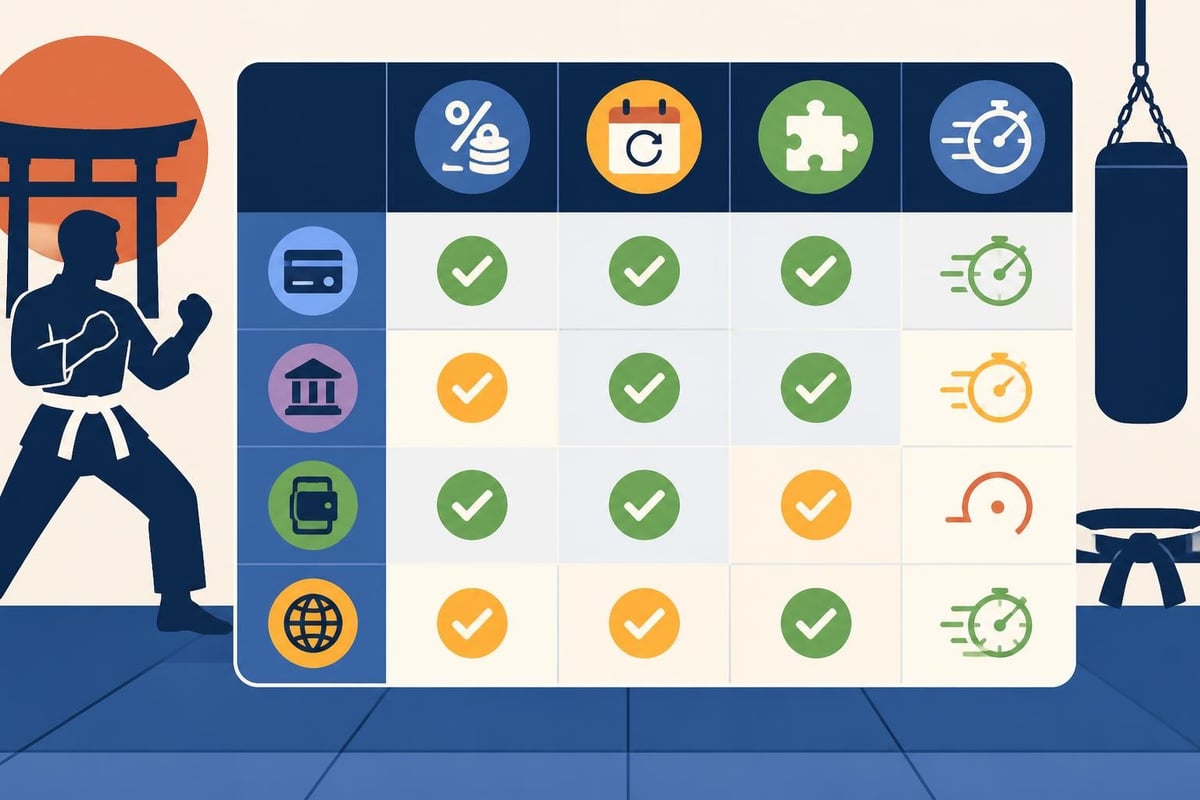
Evaluation criteria should include:
- Transaction fees: Percentage plus fixed amount per transaction
- Monthly fees: Account maintenance and gateway access charges
- Batch fees: Costs for daily settlement processing
- Chargeback fees: Penalties when members dispute charges
- Integration capabilities: API access for software connections
- Recurring billing features: Native support for subscription management
- Payment methods: Acceptance of cards, ACH, digital wallets
- Funding timeline: How quickly settled funds reach your bank account
Integration with Academy Management Software
Standalone payment processing creates data silos and duplicate entry work. When you handle payments through integrated academy management platforms like MatSync, transaction data automatically syncs with attendance tracking, belt progression, and student records.
This integration enables powerful automation. New student enrollments can trigger immediate billing setup. Belt promotions can automatically adjust membership tiers and pricing. Class attendance connects with payment status, allowing you to identify students with outstanding balances before they arrive for training.
The best practice according to payment operations experts emphasizes creating a unified payments ecosystem where data flows seamlessly between systems, reducing manual reconciliation and improving financial accuracy.
Security Best Practices Beyond Compliance
Meeting minimum PCI compliance standards represents your baseline, not your ceiling. Advanced security practices protect your academy from evolving fraud tactics and build deeper trust with your member base.
Tokenization and Data Minimization
Never store actual credit card numbers in your database. Tokenization replaces sensitive card data with unique identifiers that have no exploitable value. When you handle payments using tokenization, a breach of your systems exposes nothing useful to attackers.
Stripe's security guide emphasizes that tokenization should occur at the point of entry, before payment data ever touches your servers. The payment processor handles all sensitive data, providing tokens for your billing system to reference.
Additional security layers include:
- Two-factor authentication for staff accessing payment systems
- Role-based access controls limiting who can view transaction data
- Encrypted data transmission using TLS 1.2 or higher
- Regular software updates to patch security vulnerabilities
- Fraud detection algorithms identifying suspicious transaction patterns
According to Finix payment security research, implementing multiple security layers creates defense in depth, where bypassing one control doesn't compromise the entire system.
Fraud Prevention for Card-Not-Present Transactions
All online and phone payments are considered card-not-present transactions, which carry higher fraud risk than in-person swipe or chip transactions. Martial arts academies processing recurring online payments must implement robust fraud detection.
The Worldpay guide to card-not-present best practices recommends address verification service (AVS) and card security code (CVV) checks for all transactions. These simple verifications confirm the person entering payment details possesses the physical card and knows the billing address.
| Fraud Prevention Tool | What It Verifies | Fraud Reduction |
|---|---|---|
| AVS (Address Verification) | Billing address matches card | 25-30% |
| CVV Check | Security code from card back | 30-35% |
| 3D Secure | Cardholder authentication | 50-60% |
| Velocity checks | Transaction frequency limits | 40-45% |
| Geolocation matching | Purchase location consistency | 35-40% |
Velocity checks prove particularly valuable for academies. If the same card attempts multiple enrollments within hours, or if dozens of cards originate from the same IP address, these patterns indicate potential fraud that your system should flag for manual review.
Optimizing the Payment Experience for Members
Security and compliance matter, but member experience determines whether students complete enrollment and maintain active memberships. When you handle payments smoothly, you remove friction from the student journey.
Payment page design significantly impacts conversion rates. Forms should be mobile-responsive since many members will enroll using smartphones. Minimize required fields to essential information only. Display security badges and SSL certificates prominently to build confidence.
User experience best practices:
- Save payment methods securely for future use
- Offer multiple payment options including ACH for lower fees
- Provide clear pricing with no hidden fees or surprises
- Enable payment method updates without contacting staff
- Send payment confirmations immediately via email
- Display upcoming charge dates in member portals
- Allow flexible payment dates for financial convenience
For family memberships common in martial arts schools, consider offering flexible payment splitting. Some families prefer paying for all children with one transaction, while others want separate billing for budget management. Your payment system should accommodate both preferences.

Transparent Pricing and Billing Communication
Unexpected charges generate chargebacks and erode trust. Always communicate clearly about what members are paying, when charges will occur, and what services are included. Before processing the first payment for contracts or memberships, send a confirmation email detailing the billing schedule.
When prices change, provide advance notice. Most states require 30 days notification before billing increases take effect. This notification should explain the reason for increases and give members options to adjust or cancel services if desired.
Managing everything from one dashboard allows academy owners to track which members have been notified about billing changes and ensure compliance with communication requirements.
Handling Refunds and Chargebacks Professionally
Despite best efforts, refunds and chargebacks occur. How you handle payments disputes impacts your reputation and relationship with payment processors. High chargeback rates can result in increased fees or account termination.
Refund Policy Best Practices
Clear refund policies prevent misunderstandings. Document your policies in enrollment agreements and make them easily accessible on your website. Most martial arts academies use tiered refund structures based on timing.
Common refund frameworks:
- Trial period: Full refund within first 7-14 days
- Medical exceptions: Prorated refunds for injuries preventing training
- Relocation: Partial refunds when members move away
- Dissatisfaction: Case-by-case evaluation within first month
- Contract buyouts: Predetermined fees for early termination
Process approved refunds quickly, ideally within 3-5 business days. Delays frustrate members and may prompt them to initiate chargebacks instead.
Chargeback Prevention and Response
Chargebacks occur when members dispute charges directly with their credit card issuer. Each chargeback typically costs $15-$25 in fees, plus the reversed transaction amount. High chargeback ratios (above 1%) can classify your business as high-risk.
Prevention starts with clear communication. Ensure your business name appears recognizably on credit card statements. "MATSYNC MARTIAL ARTS" is clearer than "MS TECH LLC," which members might not recognize, leading to disputes.
According to secure payment processing guidelines, maintaining detailed transaction records enables effective chargeback disputes. Save enrollment agreements, email communications, attendance records, and any service delivery proof. When chargebacks occur, respond within the processor's deadline (usually 7-10 days) with comprehensive evidence that services were authorized and delivered.
Payment Analytics and Financial Reporting
Data from payment processing provides valuable business intelligence. When you handle payments through sophisticated systems, you gain insights into revenue trends, member retention patterns, and financial health indicators.
Key metrics to track:
- Monthly recurring revenue (MRR): Predictable income from active memberships
- Churn rate: Percentage of members canceling each month
- Average revenue per member (ARPM): Total revenue divided by active members
- Payment success rate: Percentage of attempted charges that complete successfully
- Failed payment recovery rate: Percentage of failed charges eventually collected
- Revenue by program type: Income breakdown across different training programs
This analytical approach to payment management enables data-driven decisions about pricing, program offerings, and retention initiatives. If you notice MRR declining, you can implement proactive retention campaigns before the problem compounds.
For academies serving diverse martial arts disciplines, segmenting revenue by program type reveals which offerings drive profitability. Your Brazilian Jiu-Jitsu program might generate different average revenue than your Muay Thai classes, informing resource allocation decisions.
Emerging Payment Technologies and Trends
Payment technology evolves rapidly, and staying current provides competitive advantages. Digital wallets like Apple Pay and Google Pay now represent significant transaction volume, particularly among younger demographics.
Cryptocurrency and blockchain-based payment systems remain experimental for most businesses, though academic research on secure payment systems explores their potential for enhanced security and reduced processing costs. For now, traditional payment methods remain more practical for martial arts academies.
Trends worth monitoring:
- Buy now, pay later (BNPL): Installment options for larger purchases or contracts
- Real-time payments: Instant bank transfers replacing slower ACH processing
- Biometric authentication: Fingerprint or face recognition for payment authorization
- Contactless payments: NFC technology for in-person transactions
- Embedded finance: Payment capabilities built directly into specialized software
The PayPal guide to secure payment implementation suggests that businesses should adopt new payment methods as they achieve mainstream acceptance among target demographics, balancing innovation with security considerations.
Staff Training and Payment Protocol Development
Your payment systems are only as secure as the people operating them. Staff training ensures consistent, secure handling of payment information across all interactions. Develop clear protocols for common scenarios and train all staff members who handle payments.
Training should cover when to collect payments, how to process different payment types, what information can be shared over phone or email, and procedures for handling payment disputes. Role-playing exercises help staff practice difficult conversations about declined payments or outstanding balances.
Essential training topics:
- Never writing down or verbally sharing complete card numbers
- Verifying member identity before discussing account details
- Processing refunds only through official channels
- Escalation procedures for unusual payment requests
- Recognizing and reporting potential fraud attempts
Regular refresher training keeps security top of mind. The Adobe Commerce implementation guide recommends quarterly security awareness updates to address new threats and reinforce best practices.
Create written procedures documenting every payment scenario. When new staff join your academy or temporary employees help during peak enrollment, these documents ensure consistent, secure payment handling regardless of who processes the transaction.
Successfully managing financial transactions requires balancing security, compliance, automation, and member experience. By implementing robust payment systems with proper security controls, you protect both your revenue and your students' sensitive information. MatSync streamlines how martial arts academies handle payments through automated billing, integrated payment processing, and comprehensive reporting tools designed specifically for academy management. Take control of your financial operations and focus more energy on what matters most: developing exceptional martial artists and building a thriving academy community.