How to Manage Features for Martial Arts Software
Learn how to manage features effectively in martial arts software, from rollout strategies to student experience optimization for your academy.
- By
- RankPill
- Published
- August 9, 2026
- Reading time
- 13 min read

Managing software features in a martial arts academy requires careful planning, strategic rollout, and ongoing maintenance. Whether you're running a Brazilian Jiu-Jitsu academy, karate dojo, or mixed martial arts gym, the ability to manage features effectively determines how well your platform serves both your staff and students. Modern martial arts management platforms must balance innovation with stability, ensuring new capabilities enhance operations without disrupting the student experience or overwhelming your team with unnecessary complexity.
Understanding Feature Management in Martial Arts Software
The ability to manage features goes beyond simply turning capabilities on or off. It encompasses the entire lifecycle of software functionality, from initial development through deployment, monitoring, and eventual retirement. For martial arts academy owners, this means having precise control over which features are available to different user groups, when they're released, and how they impact daily operations.
Feature management serves multiple strategic purposes within your academy's technology stack. First, it enables you to test new capabilities with select groups before rolling them out academy-wide. Second, it allows you to customize the platform experience based on membership tiers or program types. Third, it provides a safety mechanism to quickly disable problematic features without requiring code deployments.

Core Components of Effective Feature Control
Successful feature management systems incorporate several essential elements that work together to provide comprehensive control. Understanding these components helps academy owners make informed decisions about their software architecture.
Feature flags represent the fundamental building blocks of any management system. These toggles allow you to enable or disable specific functionality without changing the underlying code. In a martial arts context, you might use flags to control access to advanced belt tracking systems, specialized billing options, or integration with third-party services.
| Component | Purpose | Martial Arts Example |
|---|---|---|
| Feature Flags | Toggle capabilities on/off | Enable video replay for advanced students |
| User Segmentation | Target specific groups | Rollout booking features to competition team first |
| Rollout Percentages | Gradual deployment | Release new belt testing module to 10% of academies |
| Kill Switches | Emergency shutoff | Disable payment processing if issues detected |
User segmentation enables you to manage features based on specific criteria. You might segment by membership level, belt rank, program type, or instructor privileges. This granular control ensures students and staff only see features relevant to their needs, preventing interface clutter and confusion.
Implementing Gradual Rollout Strategies
Gradual rollouts minimize risk when introducing new capabilities to your martial arts academy. Rather than releasing features to everyone simultaneously, you can control the pace and scope of deployment. Following best practices for gradual rollout strategies ensures smooth transitions that don't disrupt classes or operations.
Start with internal testing among your instructors and administrative staff. These power users can identify issues before they affect students or parents. Once you've validated the feature internally, expand to a small percentage of your student base. Monitor usage patterns, gather feedback, and address any problems before increasing the rollout percentage.
The percentage-based approach works particularly well for features that affect the student experience. For instance, when releasing a new mobile app feature for class check-ins, you might start at five percent of active students, then increase to 25 percent, then 50 percent, before achieving full deployment. This measured approach gives you time to adjust based on real-world usage patterns.
Strategic Feature Deployment for Different Martial Arts Programs
Different martial arts disciplines and programs within your academy may require distinct feature sets. The way you manage features should reflect these variations, ensuring each program has the tools it needs without unnecessary complexity.
Program-Specific Feature Requirements
Brazilian Jiu-Jitsu programs often benefit from detailed belt progression tracking that monitors technique mastery across hundreds of specific movements. Meanwhile, boxing programs might prioritize features for tracking sparring sessions and managing equipment checkout. When you manage features at the program level, each discipline gets optimized functionality.
Consider creating feature bundles aligned with specific martial arts:
- Grappling programs (BJJ, Judo, Wrestling): Technique libraries, position tracking, rolling partner management
- Striking programs (Muay Thai, Boxing, Karate): Combination counters, bag work tracking, sparring rotation tools
- Mixed programs (MMA, Self-Defense): Cross-discipline scheduling, competition preparation modules, fitness integration
This bundling approach, when combined with proper feature management practices detailed in feature flag implementation guides, creates a tailored experience for each program without forcing irrelevant features on instructors or students.
Membership Tier Differentiation
Smart feature management enables you to offer tiered membership experiences without maintaining separate software platforms. Software subscriptions with varying feature access create revenue opportunities while ensuring all students receive appropriate functionality.
Your basic membership tier might include core features: class scheduling, attendance tracking, and basic progress monitoring. Mid-tier memberships could add video instruction libraries, advanced analytics, and priority booking. Premium tiers might unlock one-on-one coaching modules, competition preparation tools, and personalized training programs.
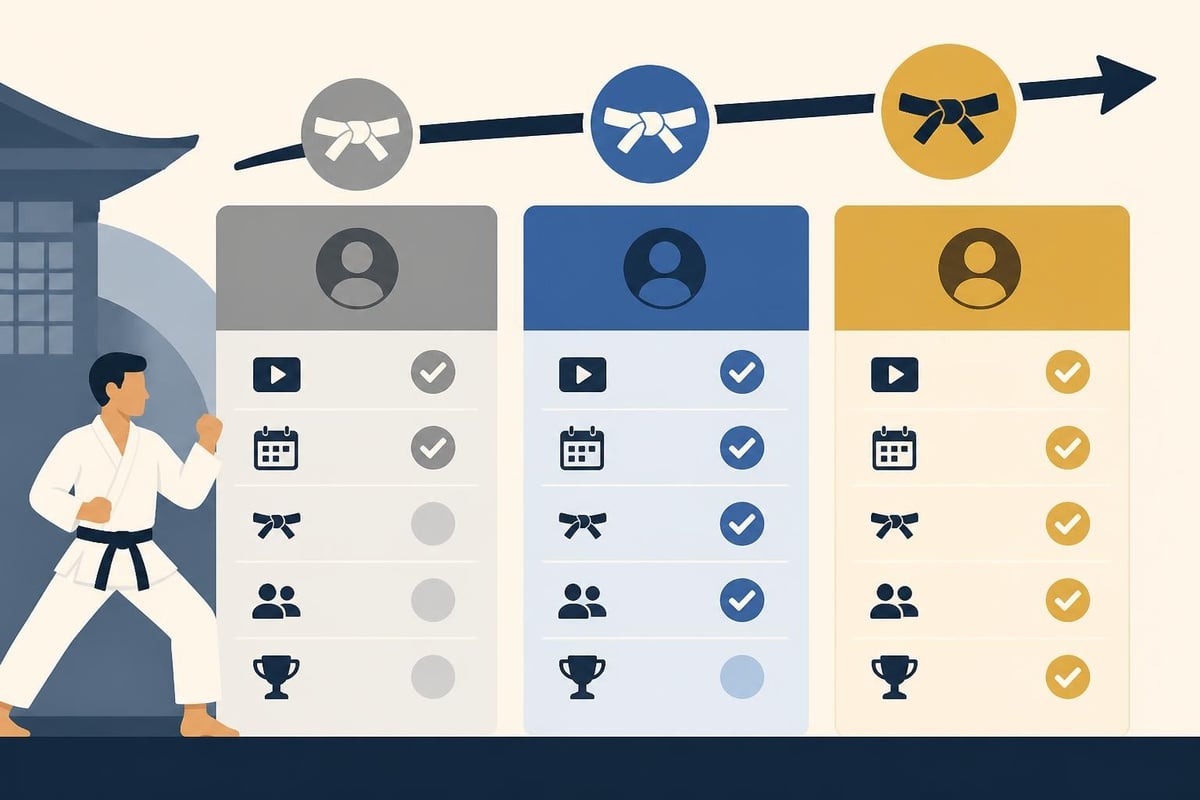
| Tier | Core Features | Advanced Features | Premium Features |
|---|---|---|---|
| Basic | Class booking, attendance | Standard progress tracking | Belt testing registration |
| Plus | All basic features | Video library access | Priority class booking |
| Premium | All Plus features | 1-on-1 scheduling | Competition prep modules, analytics dashboard |
Operational Excellence Through Feature Management
The ability to manage features directly impacts your academy's operational efficiency. When implemented thoughtfully, feature management reduces administrative burden, minimizes training requirements, and improves overall platform usability.
Reducing System Complexity
One of the most significant challenges in martial arts software is managing complexity as platforms grow. Each new feature adds potential confusion for users who don't need that specific functionality. By controlling which features appear to which users, you maintain a clean, focused interface.
Instructors teaching children's classes don't need access to competition management tools during regular class hours. Parents checking their child's progress don't need to see instructor-only administrative panels. Strategic feature management ensures each user role encounters only relevant functionality, as emphasized in effective feature flag practices.
Apply the principle of progressive disclosure: reveal advanced features only when users demonstrate the need for them. A new student's parent initially sees basic attendance and payment information. As the student advances and potentially joins the competition team, additional features become available organically.
Streamlining Staff Training and Adoption
Every new feature introduces a training requirement for your staff. When you can manage features to control timing and visibility, you reduce the training burden significantly. Rather than overwhelming new instructors with every system capability, introduce features progressively as they become comfortable with core functions.
New instructor onboarding phases:
- Week 1-2: Basic attendance marking, class roster viewing
- Week 3-4: Progress tracking, belt promotion recommendations
- Week 5-6: Parent communication tools, schedule management
- Month 2+: Advanced reporting, program planning, event coordination
This staged approach, enabled by robust feature management, improves adoption rates and reduces the resistance that often accompanies new software implementations. Working with a digital product studio during your platform selection can help ensure your chosen system supports this level of granular control.
Technical Considerations for Feature Management
While the strategic benefits of feature management are clear, successful implementation requires attention to technical details. Academy owners need platforms built with proper feature management architecture from the ground up.
Architecture and System Design
Modern feature management relies on decoupling feature availability from code deployment. This separation allows you to manage features in real-time without requiring software updates or system restarts. For martial arts academies with classes running throughout the day, this zero-downtime approach is essential, as discussed in feature flags best practices for zero downtime.
The underlying architecture should support centralized feature control through a management dashboard. This interface allows academy owners and administrators to enable, disable, and configure features across the entire platform. Changes propagate immediately to all active users without requiring them to log out or refresh their sessions.
Integration with Analytics and Monitoring
The decision to enable or disable features shouldn't be made blindly. Robust analytics integration helps you understand how features perform in real-world use. Track metrics like adoption rates, usage frequency, error rates, and user satisfaction scores for each feature.
When you release a new monthly timetable feature, monitor how many instructors actually use it within the first week. If adoption is low, that might indicate a need for better training, clearer documentation, or UX improvements. If error rates spike, you can quickly disable the feature while investigating the root cause.
Key metrics to monitor when you manage features:
- Activation rate: Percentage of eligible users who enable optional features
- Usage frequency: How often activated features are actually used
- Error rate: Technical problems encountered within specific features
- Support tickets: Help requests related to particular features
- Performance impact: System resource consumption per feature
<image_prompt alt="Feature analytics dashboard">Feature performance metrics dashboard showing adoption rates, usage patterns, error frequencies, and user satisfaction scores for different martial arts academy features</image_content>
Governance and Lifecycle Management
Effective feature management extends beyond the initial rollout. Establishing clear governance policies ensures features remain valuable over time and technical debt doesn't accumulate.
Establishing Clear Ownership and Accountability
Every feature should have a designated owner responsible for its performance, maintenance, and eventual retirement. In a martial arts academy context, this might mean your head instructor owns belt progression features, your billing manager owns payment-related features, and your competition coordinator owns tournament management features.
This ownership model, combined with practices outlined in development and collaboration strategies, ensures someone monitors each feature's ongoing value and identifies when retirement is appropriate. Owners review usage analytics quarterly, gather user feedback, and recommend whether features should be expanded, maintained as-is, modified, or deprecated.
Managing Feature Debt and Cleanup
Feature flags are temporary by design. When you manage features properly, you establish timelines for converting experimental features into permanent capabilities or removing them entirely. Allowing feature flags to accumulate indefinitely creates technical debt that complicates your codebase and increases maintenance costs.
Feature lifecycle stages:
- Development: Flag created, feature built behind it
- Beta testing: Limited rollout to test group (2-4 weeks)
- Gradual release: Percentage-based expansion (4-8 weeks)
- General availability: Feature enabled for all eligible users
- Cleanup: Flag removed, feature becomes permanent or deprecated
Set explicit deadlines for each stage. If a feature remains in beta for more than eight weeks, that signals either the feature isn't ready for broader release or it doesn't provide sufficient value to warrant continued development. Make the difficult decision to either invest in fixing it or removing it entirely, following guidance from research on feature toggle dynamics.
Feature Management for Multi-Location Academies
Martial arts organizations operating multiple locations face additional complexity when they manage features. Different locations may have varying needs based on their size, student demographics, and operational maturity.
Your flagship location with 300+ students might benefit from advanced features like automated marketing campaigns and sophisticated analytics dashboards. Meanwhile, a newer satellite location with 50 students needs simpler tools focused on core operations. Feature management enables you to provide location-appropriate functionality without forcing every location onto identical configurations.
Location-based feature deployment strategies:
- Geographic customization: Enable region-specific payment methods or language options
- Maturity-based rollout: Newer locations start with core features, adding capabilities as they grow
- Performance-based access: Unlock advanced features when locations hit operational milestones
- Franchisee control: Allow individual location owners to manage features within approved boundaries
This approach works particularly well when combined with centralized management systems that provide corporate oversight while enabling local flexibility. The headquarters team maintains visibility into which features are active at each location while empowering local managers to make appropriate decisions.
Balancing Innovation with Stability
The tension between innovation and stability represents one of the central challenges in feature management. Academy owners want access to cutting-edge capabilities that improve operations and student experience, but they also need reliable, predictable systems that don't disrupt daily classes.
Smart feature management resolves this tension by allowing you to experiment with innovation in controlled environments. Your one platform can simultaneously support stable, proven features for day-to-day operations while testing experimental capabilities with volunteer instructors or select student groups.
Establish separate tracks for different feature types:
Stable track: Proven features that all users can rely on, updated on quarterly release cycles with extensive testing
Beta track: New features available to early adopters who opt in, understanding these capabilities may change or be removed
Experimental track: Cutting-edge features in active development, available only to designated test groups
This multi-track approach, combined with principles from feature toggle management research, ensures innovation continues without compromising the stability that busy martial arts academies require.
Optimizing Student Experience Through Feature Management
Ultimately, the goal of effective feature management is delivering exceptional experiences to your students and their families. Every decision about which features to enable, for whom, and when should be evaluated through the lens of student value.
Consider how features affect the complete student journey. New students need simple, welcoming interfaces that help them book their first class and understand academy policies. The ability to manage features ensures beginners aren't overwhelmed by advanced competition tracking or complex technique libraries designed for experienced practitioners.
As students progress, their needs evolve. Management of student data should reflect this progression, with features unlocking automatically as they advance through belt ranks or program levels. This creates a sense of growth and achievement, reinforcing the value of continued training.
Parents evaluating whether to enroll their children need features that build confidence: transparent billing, clear progress tracking, easy communication with instructors. By managing features to prioritize these capabilities during the enrollment and onboarding period, you address the concerns most important to new families.
Mobile and Cross-Platform Considerations
Modern students and parents expect seamless experiences across devices. When you manage features, consider how they perform on smartphones, tablets, and desktop computers. A feature that works beautifully on a large screen might be frustrating on a mobile device.
Enable mobile-optimized features for on-the-go access: quick class check-in, schedule viewing, payment confirmation. Reserve complex features requiring detailed input or extensive navigation for desktop experiences. This device-appropriate approach, informed by feature management best practices, ensures users always have the right tools for their current context.
Successfully managing features in martial arts software requires strategic thinking, technical infrastructure, and ongoing commitment to optimization. By implementing gradual rollouts, establishing clear governance, and maintaining focus on student experience, academy owners can leverage modern platform capabilities without overwhelming their teams or students. MatSync provides martial arts academies with sophisticated feature management capabilities built specifically for the unique needs of combat sports programs, enabling you to deliver the right tools to the right users at the right time while maintaining operational excellence across your entire organization.