Monthly Timetable for Martial Arts Academies in 2026
Learn how to create and manage an effective monthly timetable for your martial arts academy. Optimize schedules, boost attendance, and improve operations.
- By
- RankPill
- Published
- July 31, 2026
- Reading time
- 12 min read

Managing a martial arts academy requires precision, organization, and strategic planning across every operational dimension. Whether you run a Brazilian Jiu-Jitsu gym, karate dojo, or mixed martial arts facility, having a comprehensive monthly timetable serves as the foundation for smooth operations, consistent student engagement, and sustainable revenue growth. A well-structured monthly timetable goes beyond simply listing class times-it becomes your strategic roadmap for instructor scheduling, facility management, student progression tracking, and business development activities.
Understanding the Monthly Timetable Framework
A monthly timetable represents a comprehensive scheduling system that organizes all academy activities across a 30-day period. Unlike weekly schedules that focus on repetitive class patterns, a monthly timetable provides the broader strategic view necessary for martial arts academies to plan special events, testing cycles, promotional periods, and operational maintenance.
The concept of monthly cadence applies directly to martial arts academy management, where certain activities naturally align with monthly rhythms. Student billing cycles, belt testing ceremonies, beginner intake programs, and instructor training sessions all benefit from monthly planning structures.
Core Components of Academy Monthly Timetables
Your monthly timetable should integrate several key operational elements:
- Class schedules with specific disciplines, skill levels, and age groups
- Instructor assignments ensuring proper coverage and expertise alignment
- Belt testing dates and promotion ceremonies
- Special events including workshops, seminars, and competitions
- Facility maintenance windows and equipment service schedules
- Marketing campaigns and enrollment period launches
- Revenue milestones and financial reporting deadlines
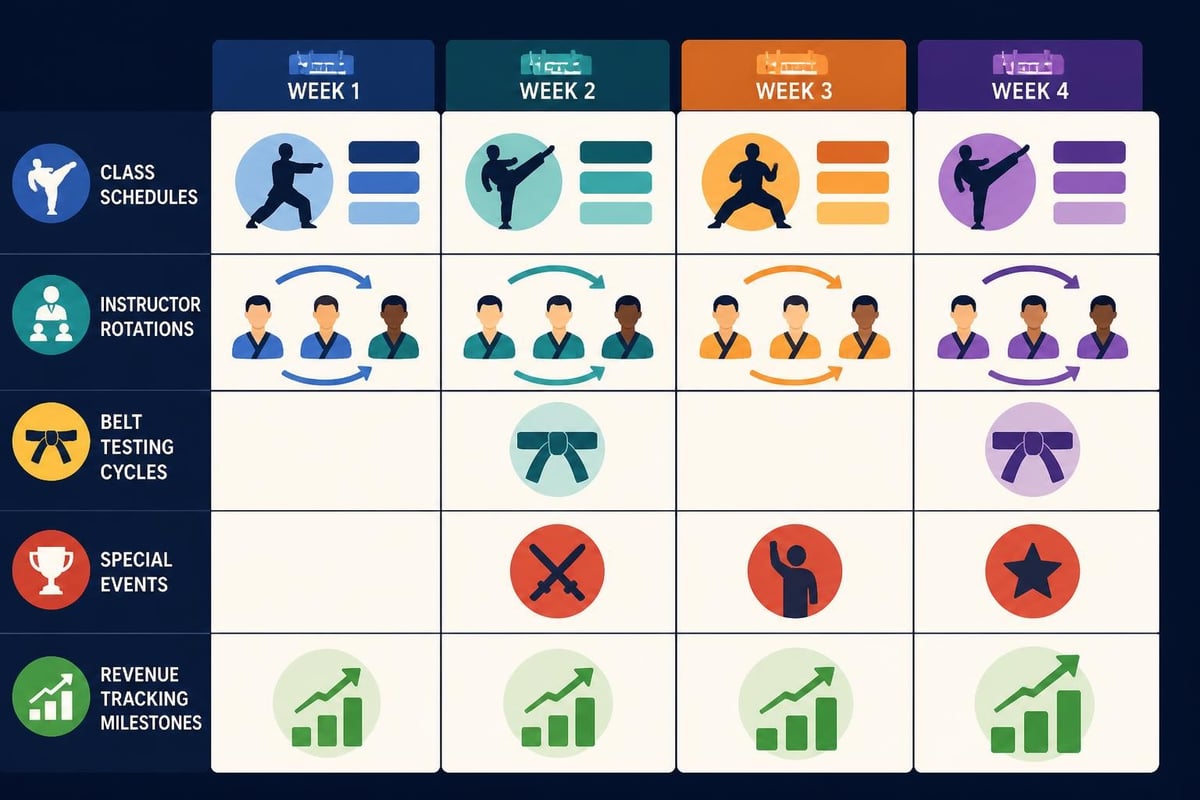
Different martial arts disciplines may require unique scheduling considerations. For instance, Brazilian Jiu-Jitsu programs often structure their monthly timetables around technique themes or positional cycles, while karate academies might align their schedules with kata progression and kumite practice sessions.
Building Your Academy Monthly Timetable
Creating an effective monthly timetable begins with understanding your academy's operational rhythms and student engagement patterns. Start by analyzing historical attendance data, identifying peak training periods, and recognizing seasonal fluctuations in enrollment.
Step-by-Step Development Process
- Map out recurring class commitments across all program levels
- Block instructor availability and identify coverage gaps
- Schedule mandatory activities including testing and special events
- Allocate marketing and enrollment windows strategically
- Build in buffer periods for unexpected adjustments
- Review revenue targets and align promotional activities
The physical format of your monthly timetable matters significantly for usability. While printable monthly schedule templates work well for wall displays in your academy, digital solutions offer superior flexibility for real-time updates and multi-location management.
Digital vs. Traditional Timetable Methods
| Feature | Digital Timetables | Paper-Based Timetables |
|---|---|---|
| Real-time updates | Instant across all platforms | Manual redistribution required |
| Accessibility | Multi-device, cloud-based | Physical location dependent |
| Integration | Connects with billing, attendance | Standalone document |
| Collaboration | Multiple editors simultaneously | Single-point editing |
| Historical tracking | Automatic archiving | Manual filing system |
Most successful martial arts academies in 2026 have transitioned to integrated digital platforms that combine monthly timetable management with attendance tracking, billing automation, and student progress monitoring. This unified dashboard approach eliminates redundant data entry and reduces scheduling conflicts.
Optimizing Class Distribution Across the Month
Strategic class distribution throughout your monthly timetable directly impacts student retention and revenue generation. Rather than maintaining identical weekly patterns, successful academies vary their offerings to maintain student interest and accommodate different training goals.
Week 1 typically focuses on foundational techniques and welcoming new students from month-start enrollment campaigns. This period should feature beginner-friendly classes and introductory programs that capitalize on New Year momentum or seasonal registration peaks.
Week 2 transitions into skill development and technique refinement. Advanced students appreciate this mid-month period for intensive training without the distraction of testing preparation or promotional events.
Week 3 often serves as the preparation phase for month-end activities. If your academy conducts monthly belt testing, this week should include review sessions and practice evaluations.
Week 4 accommodates testing ceremonies, special events, and planning for the upcoming month's initiatives. This is also when many academies review financial performance and adjust strategies accordingly.

Balancing Multiple Disciplines
Academies offering diverse martial arts programs face unique monthly timetable challenges. A facility teaching judo, boxing, and MMA must carefully allocate mat space, equipment access, and instructor resources across competing demands.
Consider creating discipline-specific mini-schedules within your master monthly timetable:
- Dedicate specific training zones to particular disciplines
- Rotate prime-time slots among different programs monthly
- Schedule cross-training opportunities that maximize facility usage
- Plan maintenance windows around discipline-specific equipment needs
Revenue Alignment in Monthly Timetables
Your monthly timetable should function as a revenue optimization tool, not merely an operational schedule. Strategic placement of revenue-generating activities throughout the month creates consistent cash flow and maximizes student lifetime value.
Revenue-Driven Scheduling Strategies
Smart academy owners align their monthly timetable with billing cycles and promotional campaigns. If your student memberships renew on the first of each month, your timetable should reflect heightened value delivery during that critical retention window.
- Early-month intensive workshops justify membership renewals
- Mid-month free trial classes convert prospects during decision-making periods
- Month-end achievement ceremonies create emotional investment before next billing cycle
The revenue increase strategies implemented through thoughtful monthly timetable design compound over time. When students see consistent value delivery through well-organized programming, retention rates improve dramatically.
Private lessons and small-group training sessions deserve strategic placement in your monthly timetable. These high-margin offerings should occupy time slots that don't cannibalize regular class attendance while appealing to students seeking personalized attention.
Instructor Management Through Monthly Planning
Effective instructor scheduling represents one of the most challenging aspects of monthly timetable creation. Martial arts instructors bring varying expertise levels, teaching styles, and availability constraints that must harmonize within your overall schedule.
Instructor Rotation Benefits
| Benefit | Impact on Academy | Impact on Students |
|---|---|---|
| Prevents instructor burnout | Sustainable staffing model | Consistent instruction quality |
| Exposes students to different styles | Attracts diverse instructor talent | Broader skill development |
| Provides coverage flexibility | Reduces schedule disruption risk | Continuous program delivery |
| Supports instructor development | Builds depth in teaching roster | Fresh perspectives in training |
Monthly timetables allow you to plan instructor professional development activities without disrupting student programming. Designate specific days each month for instructor training, certification maintenance, or competitive participation.
When managing studios offering specialized programs like kickboxing alongside traditional martial arts, ensure your monthly timetable accounts for instructor certifications and expertise areas. Students notice when instructors lack proper credentials for the techniques being taught.
Technology Integration for Monthly Timetable Management
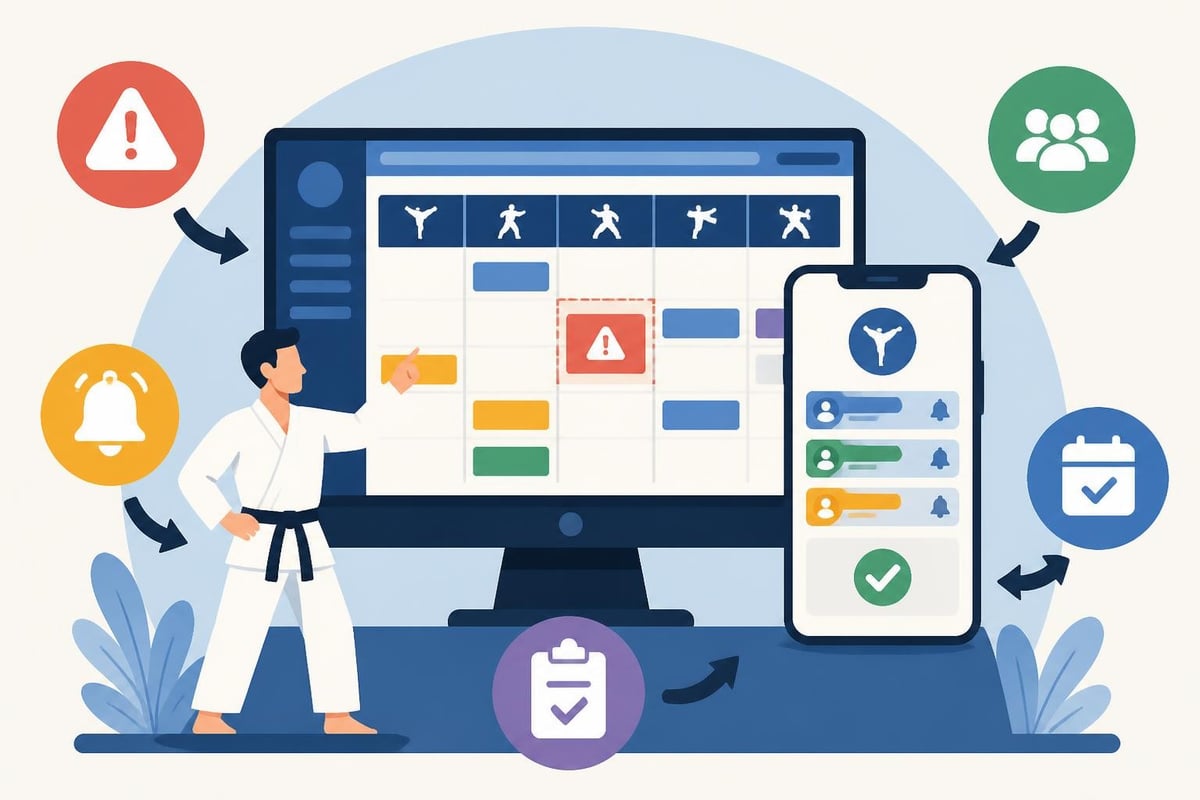
Modern martial arts academy management requires technology solutions that transform static monthly timetables into dynamic operational systems. The days of updating spreadsheets and redistributing printed schedules have given way to automated platforms that sync across all stakeholder devices.
Online monthly schedule makers provide basic functionality for visual timetable creation, but martial arts academies need more sophisticated capabilities. Integration with attendance tracking, automated billing systems, and student progress monitoring creates operational efficiency that directly impacts profitability.
Cloud-based platforms enable real-time schedule adjustments that immediately notify affected students and instructors. When an instructor calls in sick or a special event requires facility reconfiguration, updates propagate instantly across your digital ecosystem.
Essential Technology Features
- Automated conflict detection preventing double-booked resources
- Student notification systems for schedule changes or cancellations
- Attendance tracking integration showing class utilization rates
- Financial reporting connections linking schedule to revenue performance
- Mobile accessibility for students checking upcoming class availability
Many academy owners also explore supplementary platforms that complement their core management systems. For example, businesses offering diverse wellness services like multidisciplinary health care integrate scheduling across various service providers, a model that martial arts academies can adapt when offering complementary programs such as yoga, nutrition counseling, or sports therapy alongside martial arts instruction.
Special Events and Monthly Timetable Flexibility
While routine class schedules form the backbone of your monthly timetable, special events create memorable experiences that drive student engagement and community building. Successfully integrating these activities requires strategic planning and schedule flexibility.
Planning Special Event Categories
Competition preparation workshops deserve dedicated monthly timetable blocks when your students prepare for tournaments. These intensive sessions require extended time slots and often attract students from multiple regular class levels.
Guest instructor seminars provide exceptional value but disrupt normal schedules. Plan these events during traditionally slower attendance periods or weekend time slots that don't conflict with weekday commitments.
Belt testing ceremonies represent significant monthly milestones requiring careful coordination. Your monthly timetable should reflect pre-testing preparation classes, the ceremony itself, and post-testing celebration activities.
Community events like open houses, family training days, or charity fundraisers enhance your academy's local reputation. These activities might replace regular classes or occur during off-peak hours, but they deserve prominent monthly timetable placement to ensure adequate promotion and preparation.
For academies partnering with complementary service providers, collaborative events offer mutual benefits. A chiropractic practice specializing in sports injury rehabilitation might co-host injury prevention workshops at your facility, creating value for students while building community partnerships.
Monthly Timetable Communication Strategies
Even the most perfectly designed monthly timetable fails if students and instructors don't understand or access it consistently. Communication strategy matters as much as schedule design.
Multi-Channel Distribution Approach
- Physical displays in high-traffic academy areas for walk-in reference
- Email distribution at month-end previewing upcoming schedule
- Mobile app notifications highlighting schedule changes or special events
- Social media posts featuring monthly themes or focus areas
- Website integration providing 24/7 schedule access for prospects and members
Consider how platforms facilitating online booking for recreational activities make scheduling transparent and accessible. Martial arts academies should adopt similar user-friendly interfaces that allow students to view the monthly timetable, register for specific sessions, and receive confirmations seamlessly.
The complete guide to monthly planners emphasizes visual clarity and hierarchical information design-principles that apply equally to martial arts academy timetables. Use color coding for different disciplines, visual icons for special events, and clear typography for critical information.
Seasonal Adjustments to Monthly Timetables
Your monthly timetable shouldn't remain static throughout the year. Successful martial arts academies adjust their schedules seasonally to accommodate changing student availability, competitive calendars, and business objectives.
January through March typically sees enrollment surges from New Year resolution-makers. Monthly timetables during this period should emphasize beginner-friendly programming, extended trial periods, and additional class sections to accommodate increased demand.
April through June aligns with youth schedule changes including school year completion and summer preparation. Academies might introduce daytime youth programs, intensive training camps, or adjusted evening schedules as student availability shifts.
July and August present unique challenges and opportunities. While some students vacation, others seek intensive summer training. Monthly timetables might consolidate some classes while adding specialized programs targeting committed students.
September through December brings back-to-school routine and holiday season considerations. Monthly timetables should reflect more structured schedules early in this period, then build flexibility around November and December holidays while maintaining engagement through year-end testing cycles and achievement recognition.
Measuring Monthly Timetable Effectiveness
Data-driven refinement separates adequate monthly timetables from exceptional ones. Systematic measurement reveals which schedule elements drive results and which require adjustment.
Key Performance Indicators
| Metric | What It Reveals | Optimization Action |
|---|---|---|
| Class attendance rates | Student engagement by time slot | Shift popular content to peak times |
| Student-to-instructor ratios | Resource allocation efficiency | Adjust class caps or add sections |
| New student conversion rates | Trial program effectiveness | Refine beginner class scheduling |
| Revenue per scheduled hour | Financial return on facility time | Prioritize high-value programming |
| Cancellation frequency | Schedule stability issues | Improve instructor coverage planning |
Monthly timetable analytics should inform continuous improvement. If Tuesday evening classes consistently underperform while Thursday sessions reach capacity, your data suggests a scheduling adjustment opportunity. Similarly, if special weekend workshops generate strong attendance but limited revenue, pricing or positioning changes merit consideration.
Professional service providers offering monthly planning templates often include analytics features that track usage patterns-capabilities that martial arts management platforms should replicate for academy-specific metrics.
Compliance and Safety Considerations
Monthly timetable development must account for regulatory compliance, safety protocols, and risk management requirements specific to martial arts instruction.
Ensure your monthly timetable reflects appropriate student-to-instructor ratios for different age groups and skill levels. Regulatory requirements vary by jurisdiction, but safety best practices remain universal. Children's classes require closer supervision ratios than adult programs, and beginner sessions need more instructor attention than advanced training groups.
Equipment maintenance schedules integrated into your monthly timetable prevent safety hazards and extend asset lifespan. Designate specific days for mat cleaning, heavy bag inspection, protective gear sanitization, and facility deep cleaning. These operational necessities deserve formal monthly timetable placement rather than being handled reactively.
Insurance compliance often requires documented safety protocols and instructor certification maintenance. Your monthly timetable should include regular safety training refreshers and credential renewal tracking to maintain coverage and minimize liability exposure.
A thoughtfully designed monthly timetable transforms your martial arts academy from a loosely coordinated collection of classes into a strategic operation optimized for student success and business growth. By integrating class schedules, instructor management, special events, revenue planning, and operational necessities into one cohesive monthly framework, you create predictability for students while maintaining flexibility for continuous improvement. MatSync streamlines this entire process through automated scheduling, integrated billing, and comprehensive analytics, allowing academy owners to focus on what matters most-delivering exceptional martial arts instruction and building thriving communities.