Mobile App Management Software for Martial Arts Schools
Discover how mobile app management software enhances security, streamlines operations, and improves student engagement for martial arts academies in 2026.
- By
- RankPill
- Published
- June 25, 2026
- Reading time
- 13 min read

Mobile applications have become essential tools for martial arts academies, enabling instructors to track student progress, automate billing, manage class schedules, and communicate with families. However, as academies increasingly rely on mobile technology to run their operations, the need for robust mobile app management software has become critical. This specialized software ensures that applications remain secure, function optimally, and deliver consistent experiences across different devices and operating systems. For martial arts school owners, understanding how to effectively manage mobile applications can mean the difference between streamlined operations and security vulnerabilities that threaten both business data and student privacy.
Understanding Mobile App Management in the Martial Arts Context
Mobile app management software represents a comprehensive approach to controlling, securing, and optimizing mobile applications within an organization. Unlike simple device management tools, these platforms focus specifically on the application layer, providing granular control over how apps function, who can access them, and what data they can process.
For martial arts academies, this technology addresses unique operational challenges. Instructors use mobile apps to check students in for classes, update belt rankings, record technique progress, and process payments on the spot. Parents rely on mobile access to view schedules, make payments, and track their children's advancement. Administrative staff need secure access to financial records and student information from various locations.
Core Components of Application Management Systems
Mobile app management software typically includes several key components that work together to create a secure and efficient ecosystem:
- Application distribution and deployment controls how apps are installed and updated across devices
- Security policies that enforce encryption, authentication, and data protection standards
- Configuration management to customize app settings and features for different user groups
- Performance monitoring to identify issues before they impact user experience
- Access controls that determine which users can access specific features or data
The integration of these components creates a protective layer around business-critical applications, ensuring they operate reliably while maintaining data security standards.

Security Challenges in Mobile Application Environments
The mobile landscape presents unique security challenges that traditional desktop-focused security measures cannot adequately address. Mobile app security remains a significant blind spot for many organizations, with confidence levels far exceeding actual security posture.
Martial arts academies handle sensitive information that requires protection: student names, ages, addresses, payment information, health disclosures, and attendance records. When this data moves through mobile applications, it becomes vulnerable to interception, unauthorized access, and breaches.
Common Vulnerabilities in Academy Applications
| Vulnerability Type | Risk Level | Potential Impact |
|---|---|---|
| Unsecured data transmission | High | Payment information exposure |
| Weak authentication | High | Unauthorized account access |
| Insufficient encryption | Medium | Student data compromise |
| Outdated dependencies | Medium | Exploitable security gaps |
| Improper session handling | Low | Account hijacking potential |
Mobile app management software addresses these vulnerabilities through enforced security policies. It can require multi-factor authentication before accessing financial data, mandate encryption for all data transmissions, and automatically update applications to patch security vulnerabilities.
The challenge extends beyond the application itself. The invisible supply chain within mobile apps includes third-party libraries, software development kits, and external dependencies that can introduce unforeseen vulnerabilities. Management software helps track these components and flag potential security issues before they become exploitable weaknesses.
Operational Benefits for Martial Arts Academies
Beyond security, mobile app management software delivers substantial operational advantages that directly impact how martial arts schools function daily. These benefits translate into time savings, reduced technical complexity, and improved student experiences.
Centralized application control means academy owners can manage all mobile aspects of their operations from a single dashboard. When a new instructor joins the team, administrators can provision access to necessary features within minutes. When an instructor leaves, access can be revoked instantly across all devices, preventing unauthorized access to sensitive student information.
Streamlining Multi-Location Operations
For academies with multiple locations, mobile app management software becomes even more valuable. Different locations may require different feature sets, pricing structures, or class schedules. Management platforms allow administrators to configure applications differently for each location while maintaining centralized oversight.
Consider a martial arts organization offering Brazilian Jiu-Jitsu, karate, and MMA programs across three locations. Each location might have unique belt testing requirements, pricing tiers, and instructor credentials. Mobile app management software enables customized configurations that reflect these differences while ensuring consistent branding and core functionality.
Key operational improvements include:
- Automated application updates that roll out simultaneously across all devices
- Consistent user experiences regardless of device type or operating system
- Reduced technical support burden through centralized troubleshooting
- Real-time performance monitoring to identify and resolve issues proactively
- Simplified onboarding processes for new staff members
Evaluating Mobile App Management Solutions
Selecting appropriate mobile app management software requires careful consideration of organizational needs, technical requirements, and long-term scalability. Evaluating mobile application management software involves assessing both immediate functionality and future growth potential.

Essential Features for Academy Management
Not all mobile app management software offers the same capabilities. Martial arts academies should prioritize features that align with their specific operational requirements.
Must-have features include:
- App wrapping capabilities that add security layers without modifying source code
- Containerization to separate business data from personal data on shared devices
- Remote wipe functionality to protect data if devices are lost or stolen
- Usage analytics to understand how instructors and students interact with applications
- Integration support for connecting with existing billing, scheduling, and student tracking systems
The platform should support both iOS and Android devices, as families and instructors use various device types. Cross-platform compatibility ensures consistent functionality regardless of hardware choices.
Balancing Functionality and Cost
Mobile application management tools must balance service and cost effectively. Small academies with limited budgets need different solutions than large organizations with extensive IT resources.
Pricing models vary significantly across providers. Some charge per device, others per user, and some offer flat-rate licensing. For martial arts academies, per-user pricing often makes the most sense, as it scales naturally with student enrollment and instructor count.
| Pricing Model | Best For | Typical Cost Range |
|---|---|---|
| Per-device | Fixed device count | $3-8/device/month |
| Per-user | Growing academies | $5-15/user/month |
| Flat-rate | Large organizations | $500-2000/month |
| Feature-based | Specific needs | Variable |
Hidden costs deserve attention during evaluation. Implementation fees, training expenses, ongoing support charges, and integration costs can substantially increase total ownership expenses beyond base subscription fees.
Implementation Strategies and Best Practices
Successfully implementing mobile app management software requires thoughtful planning and phased execution. Rushing deployment often leads to user resistance, technical issues, and incomplete security coverage.
The implementation process should begin with a comprehensive assessment of current mobile application usage. Document which applications instructors use, what data they access, and which devices they operate. This inventory forms the foundation for configuration decisions and policy development.
Phased Deployment Approach
Rather than deploying mobile app management software across the entire organization simultaneously, a phased approach reduces risk and allows for iterative improvements.
Recommended deployment phases:
- Pilot phase with a small group of tech-savvy instructors
- Feedback collection to identify usability issues and technical problems
- Policy refinement based on real-world usage patterns
- Expanded rollout to additional instructors and administrative staff
- Full deployment including parent access and student-facing features
- Ongoing optimization through continuous monitoring and adjustment
This methodical approach minimizes disruption to daily operations while building organizational confidence in the new system. It also provides opportunities to address concerns before they become widespread problems.
Training represents a critical success factor. Even the most sophisticated mobile app management software fails if users don't understand how to work within its parameters. Develop role-specific training materials that address the actual tasks instructors and administrators perform daily. Video tutorials, quick reference guides, and hands-on practice sessions increase adoption rates and reduce support tickets.
Integration With Existing Academy Systems
Mobile app management software doesn't operate in isolation. It must integrate seamlessly with existing systems that academies rely on for billing, attendance tracking, student progress monitoring, and communication. Poor integration creates data silos, duplicates effort, and introduces errors.
Modern martial arts academies often use specialized platforms to manage their operations. These systems handle complex tasks like tracking student data across multiple belt levels, managing recurring billing cycles, and coordinating class schedules across different programs.
API Connectivity and Data Synchronization
Application Programming Interfaces (APIs) enable different software systems to communicate and share data. Mobile app management software should offer robust API support that facilitates connections with academy management platforms, payment processors, and communication tools.
Real-time data synchronization ensures that information remains consistent across all systems. When an instructor updates a student's belt rank through a mobile app, that change should immediately reflect in the central management system, parent portal, and reporting dashboards. Delays or discrepancies create confusion and undermine trust in the technology.
Critical integration points include:
- Payment processing systems for secure financial transactions
- Student information databases for attendance and progress tracking
- Communication platforms for announcements and notifications
- Scheduling systems for class management and instructor assignments
- Reporting tools for business analytics and performance monitoring
The integration architecture should support both push and pull data flows, allowing mobile applications to send updates to central systems and retrieve current information as needed.
Managing Different Martial Arts Disciplines
Different martial arts disciplines have unique requirements that mobile applications must accommodate. A boxing program tracks different metrics than a judo program, and mobile app management software must support these variations.
Mobile app management software enables customization that respects these differences while maintaining operational consistency. Administrators can configure application features to match each discipline's specific needs without deploying entirely separate applications.
Discipline-Specific Configurations
| Discipline | Key Tracking Metrics | Unique Requirements |
|---|---|---|
| Brazilian Jiu-Jitsu | Technique mastery, rolling time, position drilling | Gi and no-gi session differentiation |
| Karate | Kata proficiency, kumite performance, kihon execution | Form video recording and review |
| MMA | Striking accuracy, grappling success, conditioning levels | Cross-discipline skill integration |
| Muay Thai | Pad work rounds, clinch time, technique combinations | Equipment usage tracking |
This configurability ensures that instructors have access to relevant tools while students receive appropriate feedback for their specific martial arts journey. Mobile app management software makes these customizations manageable at scale, even for academies offering multiple disciplines under one roof.
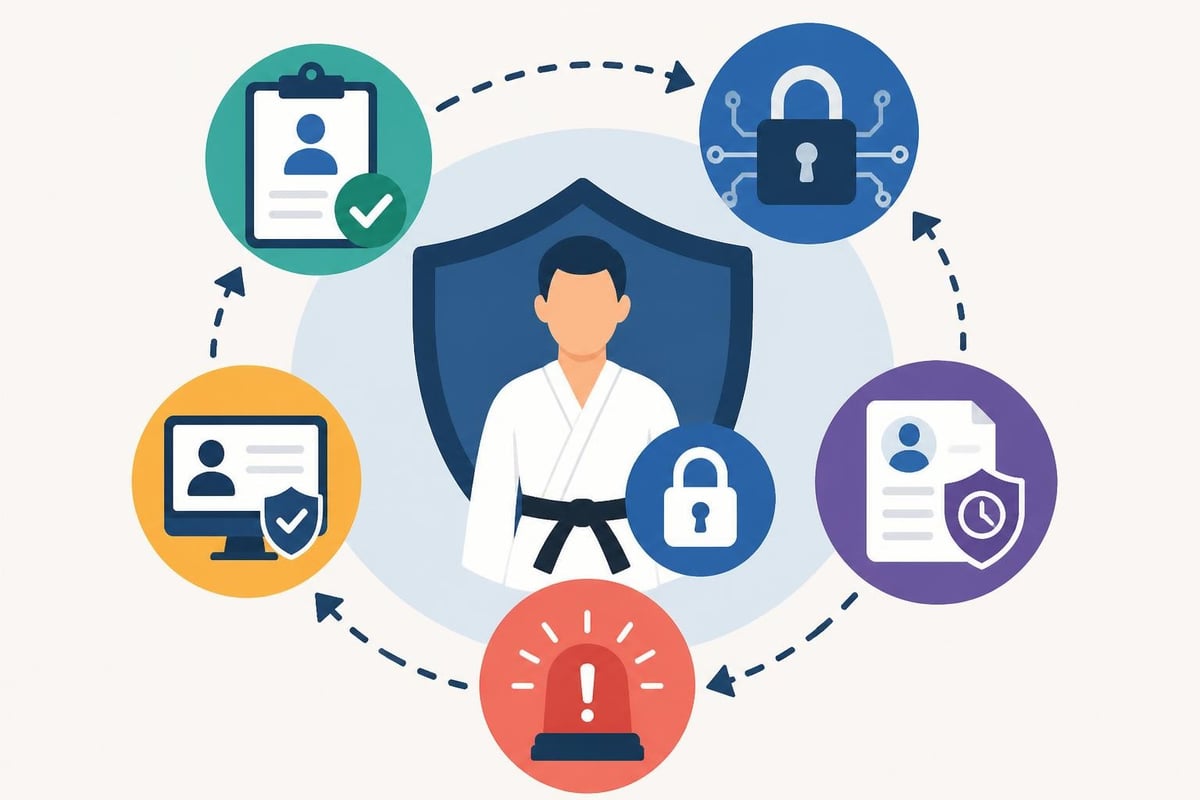
Privacy Compliance and Data Protection
Martial arts academies must comply with various privacy regulations when collecting, storing, and processing student information through mobile applications. Children's data receives additional protection under laws like the Children's Online Privacy Protection Act (COPPA), making compliance particularly important for youth-focused programs.
Mobile app management software helps maintain compliance through enforced policies, audit trails, and data protection mechanisms. It can restrict which data types mobile applications can collect, require parental consent before processing children's information, and maintain detailed logs of data access for regulatory reporting.
Building a Privacy-First Framework
Privacy protection starts with data minimization principles. Applications should only collect information necessary for specific operational purposes. Mobile app management software can enforce these limits, preventing applications from requesting unnecessary permissions or collecting extraneous data.
Encryption standards protect data both in transit and at rest. Management platforms should enforce strong encryption protocols for all data transmissions between mobile devices and backend systems. They should also ensure that data stored on mobile devices remains encrypted, protecting it even if a device is lost or stolen.
Essential privacy controls include:
- Granular permission management for camera, location, and contact access
- Automatic data deletion after specified retention periods
- Consent management workflows for parental authorization
- Data portability features enabling information export upon request
- Breach notification systems that alert administrators to security incidents
These controls demonstrate respect for student and family privacy while protecting the academy from regulatory penalties and reputational damage.
Performance Monitoring and Optimization
Mobile app management software provides visibility into application performance, helping identify issues before they impact user experience. Performance monitoring tracks metrics like load times, crash rates, feature usage, and error frequencies across different devices and operating systems.
For martial arts academies, application performance directly affects operational efficiency. Slow check-in processes create lobby congestion and frustrated families. Crashing applications during billing cycles delay revenue collection. Unresponsive scheduling features prevent students from registering for classes.
Key Performance Indicators
Establishing baseline performance metrics enables data-driven optimization decisions. Mobile app management software should track and report on indicators that matter for academy operations.
Critical performance metrics:
- Application launch time for quick access during busy periods
- Transaction completion rates for payment processing success
- Feature adoption percentages showing which capabilities users value
- Error frequencies indicating technical problems requiring attention
- Device-specific performance revealing compatibility issues
Regular performance reviews identify trends and opportunities for improvement. If check-in times increase during peak hours, load balancing adjustments or infrastructure upgrades may be necessary. If certain features show low adoption rates, user interface improvements or additional training might help.
Future Considerations for Mobile Management
The mobile technology landscape continues evolving rapidly, with new capabilities, security threats, and user expectations emerging constantly. Mobile app management software must adapt to these changes while maintaining stability and security.
Artificial intelligence and machine learning are increasingly integrated into mobile applications, enabling predictive analytics, personalized recommendations, and automated decision-making. For martial arts academies, this might mean applications that predict student retention risks, suggest optimal class schedules based on attendance patterns, or identify students ready for belt advancement.
Preventing attacks on mobile applications requires ongoing vigilance and adaptation. New attack vectors emerge as technology evolves, making static security approaches insufficient. Mobile app management software should include threat intelligence feeds that provide real-time information about emerging vulnerabilities and recommended countermeasures.
Preparing for Technological Advancement
Academy owners should select mobile app management software that demonstrates commitment to innovation and continuous improvement. Regular feature updates, security patches, and platform enhancements indicate vendor investment in long-term product viability.
Consider the vendor's roadmap and vision for future capabilities. Are they incorporating emerging technologies like biometric authentication, blockchain-based credential verification, or augmented reality training tools? While not every innovation proves valuable, vendors that actively explore new possibilities are more likely to remain competitive as the market evolves.
The shift toward cloud-native architectures and microservices-based applications offers improved scalability and resilience. Mobile app management software should support these modern architectural patterns, enabling academies to leverage advanced capabilities as they become available without wholesale system replacements.
Effective mobile app management software provides martial arts academies with the security, control, and operational efficiency needed to leverage mobile technology safely and productively. By implementing comprehensive management solutions, academy owners protect sensitive student information while delivering the convenient, responsive experiences that modern families expect. MatSync offers martial arts academies a complete platform that integrates secure mobile access with billing automation, attendance tracking, and progress monitoring, enabling school owners to focus on what matters most: developing exceptional martial artists while building thriving businesses.