Karate Belt Order: Every Color, Kyu and Dan Grade Explained
The common karate belt order from white to black, why styles like Shotokan and Kyokushin differ, how long each belt takes, and what dojo owners should put in a grading policy.
- By
- MatSync Editorial
- Published
- October 16, 2026
- Reading time
- 9 min read
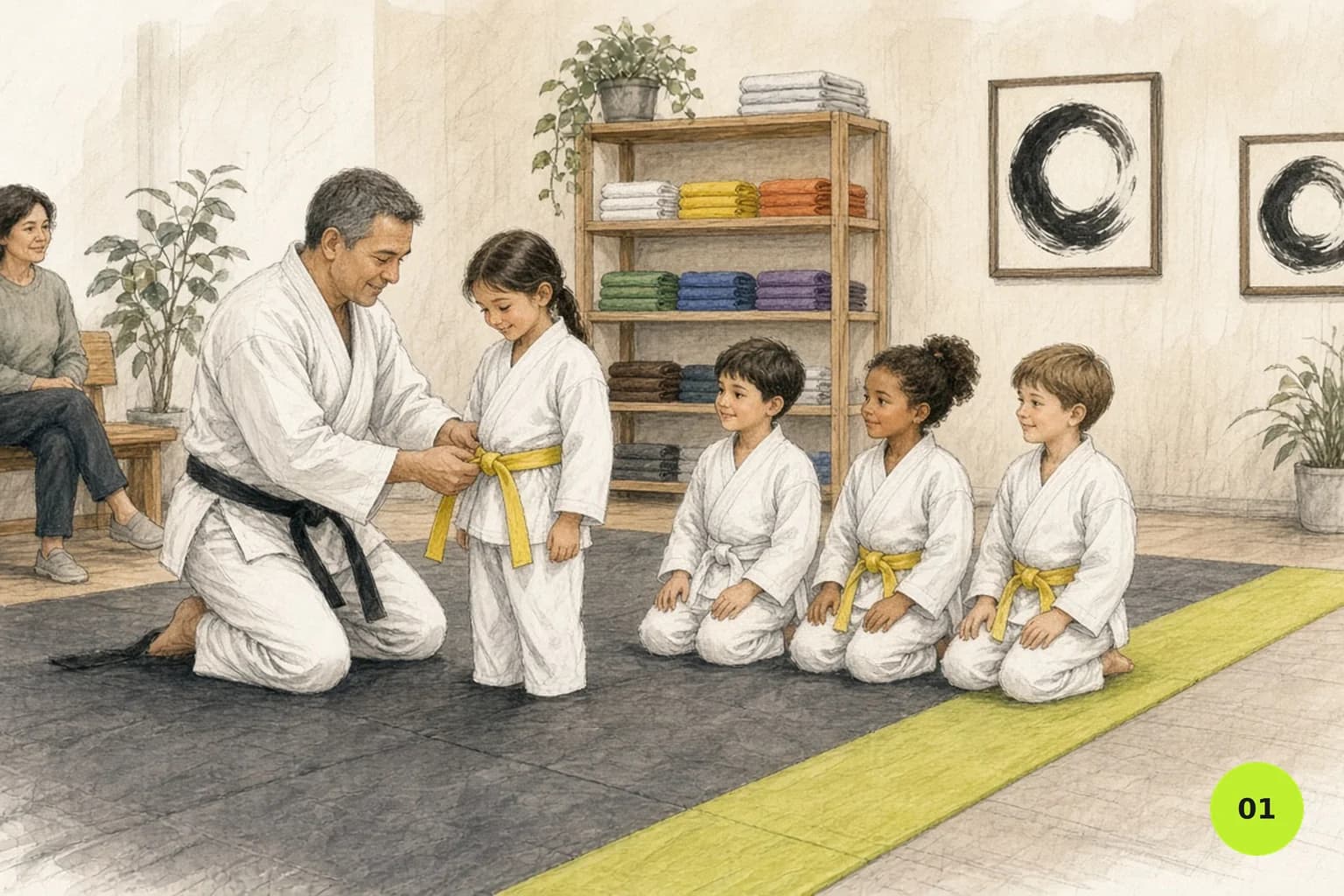
If you're looking for the one official karate belt order, there isn't one. Karate has no single body that sets belt colors for every style and dojo. What almost every school shares is the structure underneath: colored belts for the kyu (student) grades, counting down toward 1st kyu, then black belt dan grades that count up from 1st dan. The colors in between are chosen by the style, the association, or sometimes just the dojo.
So the short answer is this. White comes first, black comes after the last kyu grade, and the colors in the middle depend on where you train. Below is the most common karate belt order, how the big styles differ, how long each stage tends to take, and what dojo owners should write down so they stop answering the same question from parents every week.
The most common karate belt order
Many dojos use something close to this sequence. Treat it as a typical pattern, not a rule.
| Belt color | Typical kyu grade | Stage |
|---|---|---|
| White | 10th kyu, or ungraded | Beginner |
| Yellow | 9th to 8th kyu | Beginner |
| Orange | 8th to 7th kyu | Beginner |
| Green | 6th kyu | Intermediate |
| Blue | 5th kyu | Intermediate |
| Purple | 4th kyu | Intermediate |
| Brown | 3rd to 1st kyu | Advanced |
| Black | 1st dan (shodan) and up | Dan grades |
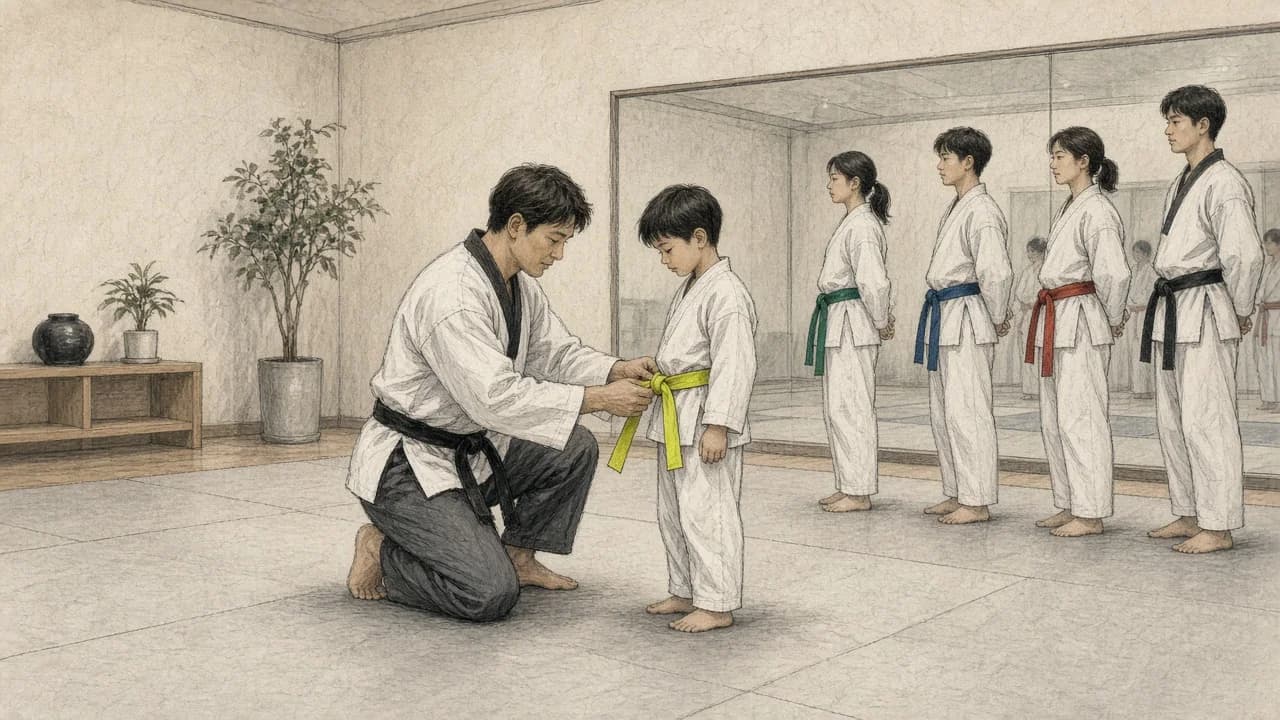
Plenty of schools add stripes or colored tips between full belts: a white belt with a yellow tip, or brown with one, two or three stripes. Kids' programs usually have more of these steps than adult programs. That's deliberate. A seven-year-old who waits a whole year for a new color tends to quit.
Watch the numbering, because it confuses almost every new parent. Kyu grades count down, so a 9th kyu is newer than a 5th kyu. Dan grades count up, so a 3rd dan outranks a 1st dan.
What you learn at each karate belt
Syllabi differ between styles and dojos, but the stages below hold for most schools. Your club's grading sheet has the exact techniques and kata.
White belt (10th kyu)
White belt is about learning how the dojo works: bowing in, lining up, the basic stances such as front stance (zenkutsu-dachi), and the first punches, blocks and kicks. A first grading usually checks that you can do these basics with control, not power.
Yellow belt (9th kyu)
The first earned color in many schools. Students join basics into short combinations and often learn their first kata. In Shotokan that is usually Heian Shodan, sometimes preceded by a Taikyoku form.
Orange belt (8th kyu)
More combinations, steadier balance on turns, and in many dojos the first pre-arranged partner drills, where one student attacks and the other defends with set techniques.
Green belt (7th to 6th kyu)
The middle of the kyu grades. Kata get longer, and many schools start light, supervised free sparring. This is usually when students first ask how long black belt will take.
Blue belt (5th kyu)
Blue tends to mark the shift from learning techniques to using them: timing, distance and moving between attack and defense.
Purple belt (4th kyu)
The last color before brown in most systems. Instructors expect cleaner kata and more consistent sparring, and gradings get noticeably harder.
Brown belt (3rd to 1st kyu)
Brown often covers three grades, sometimes shown with one to three stripes. Students refine everything they know, prepare the kata for their black belt test and often help with beginners. Many instructors keep students at brown longer than at any other color.
Black belt (1st dan and up)
Shodan, the first black belt, is usually described as the start of serious study rather than the finish line. From here the ranks count up, and the wait between gradings grows with each dan.
Where kyu and dan come from
Karate didn't invent the system. Jigoro Kano, who founded judo, awarded the first dan ranks in 1883, and it was 1886 before he had his dan-grade students wear a different belt from everyone else, according to USA Judo's history of black belt promotions. Karate teachers in Japan borrowed the idea in the decades that followed. That's why karate and judo use the same words for rank.
Today each large association publishes its own grading rules. The Japan Karate Association, one of the biggest Shotokan organizations, lists 10 kyu and 10 dan grades and holds kyu gradings twice a year. Its dan requirements get steep quickly. You need a year at 1st dan before testing for 2nd, two years at 2nd dan before 3rd, and the gaps keep growing until they reach seven, eight and nine years near the top. The highest dan grades can only be examined at JKA headquarters in Tokyo.
How the belt order differs between karate styles
Two dojos in the same town, both teaching Shotokan, can still use different colors. The association a club belongs to usually matters more than the style name on the sign. A few patterns you'll run into:
- Shotokan clubs mostly follow something close to the table above, though some put a red belt near the start or use purple with a white stripe before brown.
- Many Kyokushin dojos start new students on orange instead of white, and use a black stripe on a belt to mark the half step before the next color.
- Goju-ryu, Wado-ryu and Shito-ryu associations each publish their own syllabus, and independent dojos often simplify those.
- Sport karate doesn't show rank on the mat at all.
That last one surprises people. Under the World Karate Federation's kumite rules, each competitor wears a red belt (aka) or a blue belt (ao) as allocated by the draw, and the rules state that "belts of grade cannot be worn during the bout" (WKF Kumite Competition Rules 2024). In a WKF match, a black belt and a green belt look exactly the same.
If you train under an association, its grading syllabus is the document to trust. If your dojo is independent, the head instructor decides, and that's fine.
How long it takes to get each karate belt
This question usually arrives around green belt. The honest answer depends on three things: how often you train, how often your dojo holds gradings, and whether there's a minimum time or class count at each rank.
Some quick arithmetic helps. If your dojo grades three times a year and you pass every test, ten kyu grades take a little over three years on paper. Real life is slower. People miss gradings for holidays, injuries and work, and many instructors make students wait longer at brown belt. Adults who train two or three times a week commonly land somewhere between four and six years. To estimate your own timeline from your current kyu and how often you train, try the karate belt calculator. Children often take longer, because many schools hold juniors at a junior black belt until they're old enough for the adult grade.
Black belt doesn't speed anything up. Using the JKA minimums above, someone who passes every dan test at the first chance still needs six years to get from 1st dan to 4th dan.
What the belt colors are said to mean
You'll find a tidy story on lots of karate websites. White is a seed, yellow is the first sunlight, green is a growing plant, brown is ripening, black is maturity. It's a nice teaching device, and plenty of instructors use it with kids. It's also mostly modern storytelling. The related tale that a white belt slowly turns black from years of sweat and dirt is a myth too.
Use the seed story if it helps your students stay motivated. Just don't present it as ancient tradition.
For dojo owners: write your belt order down
Most grading arguments in a dojo aren't really about technique. They're about expectations. A parent thinks their child is due a belt because a friend at another club got one after three months, and nobody at your club ever said what the rules are.
A one-page grading policy prevents most of that. Put in:
- the full belt order for each program, including stripes or tips
- the minimum number of classes and months at each rank before a student can test
- what you assess at each grading, such as kihon, kata, kumite and conduct
- grading fees, if you charge them
- how juniors move into the adult syllabus
Then keep records that actually match the policy. If the rule is 40 classes and four months at green belt, someone has to know who has reached 40 classes. Paper attendance cards are fine for a 20-student club. Past that, most owners end up with a spreadsheet nobody trusts.
That record-keeping is what MatSync is built for. You can set up your own rank system for each discipline and age group, give every belt its color plus a second color for stripes or tips, and attach a minimum number of classes and months to each rank. Attendance counts toward those minimums, so the progress board shows who is ready to test, who is close and who isn't there yet, and you can put a student on hold or schedule a promotion. Our guide to belt tracking software for martial arts clubs covers that workflow in more detail, and there's a broader piece on tracking student progress. If you run a karate school, you can also see how MatSync is set up for karate dojos.
Quick answers about karate belts
What is the first belt in karate? White, in most schools. Some Kyokushin dojos start students on orange.
What comes after black belt? More black belt. Dan grades count up from 1st dan, and large associations such as the JKA go to 10th dan.
How many belts are there in karate? Most dojos use between six and nine belt colors. Behind the colors there are usually 10 kyu grades before black belt and up to 10 dan grades after it.
What belt comes after yellow in karate? Usually orange. Some schools go straight from yellow to green, and Kyokushin uses a different order.
Does karate have a red belt? In some styles, yes. A few Kyokushin groups use red for the first grades, and some associations borrow judo's custom of red-and-white or red belts for very senior dan grades.
What is the highest belt in karate? 10th dan, in associations that go that far. Very few people ever hold a grade above 8th dan.
Is brown belt higher than blue belt? In most karate systems, yes. Brown is usually the last color before black.
Do all karate schools use the same belt order? No. The style, the association and the dojo can all change it. Ask your instructor for the written syllabus.