BJJ Belt Order: Adult, Kids and Stripe Ranks Explained
The BJJ belt order for adults and kids under the June 2026 IBJJF rules, how stripes and black belt degrees work, the minimum time at each belt and what changes at age 16.
- By
- MatSync Editorial
- Published
- October 16, 2026
- Reading time
- 8 min read
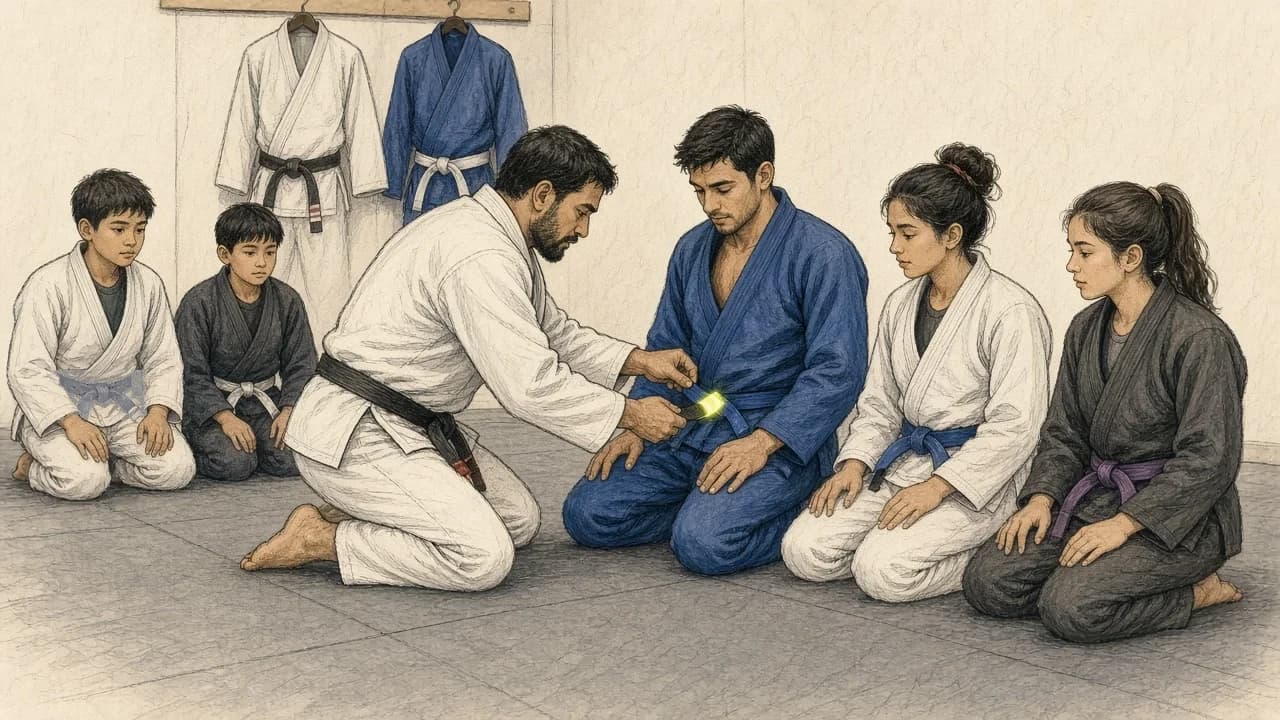
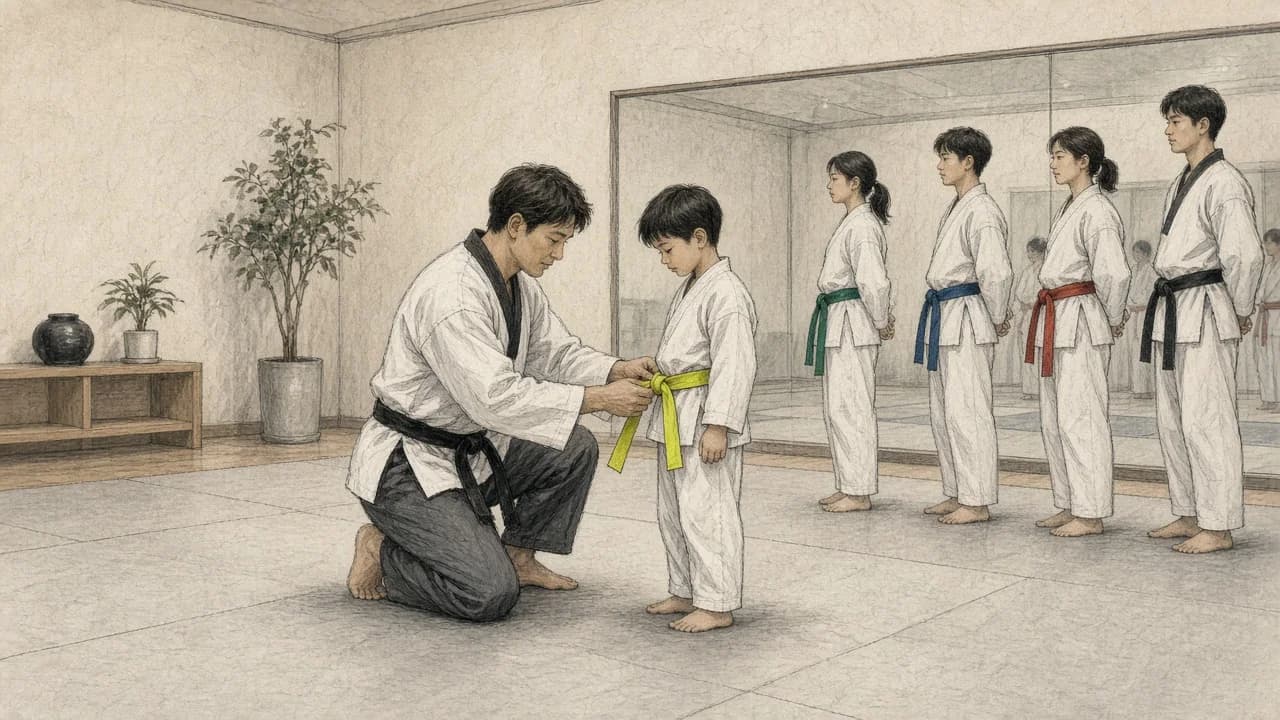
The adult BJJ belt order is short: white, blue, purple, brown, black. Five belts. Karate and taekwondo have ten or more colored grades, so it makes sense that each Brazilian jiu-jitsu belt takes years, not months. Children have their own system with thirteen belts, and black belts keep going through degrees and into red and black, red and white, and finally red.
The rules below come from the International Brazilian Jiu-Jitsu Federation's General System of Graduation, the version published in June 2026. Most academies follow it, even plenty that aren't IBJJF members, because the colors are almost universal. The minimum times and ages only matter for official recognition, but they're a handy reference either way.
The adult BJJ belt order (16 and older)
| Belt | Minimum age (IBJJF) | Minimum time at the belt (IBJJF) |
|---|---|---|
| White | Any age | None |
| Blue | 16 | 2 years |
| Purple | 16 | 1.5 years |
| Brown | 18 | 1 year |
| Black | 19, or 18 for adult world champions at brown belt (IBJJF) | 31 years before red and black |
Note: the IBJJF minimum times apply from age 18. If you're 16 or 17, there's no minimum time at white or blue belt.
The minimum time is how long you have to hold a belt before you can move up. So a blue belt needs two years at blue before purple, a purple belt needs a year and a half before brown, and a brown belt needs a year before black. There are shorter routes for people who came through the kids belts or won the adult world championship at their belt. For example, someone who was registered as a green belt as a child has no minimum time at adult blue.
The June 2026 update changed one thing. Under the IBJJF rule, you can now be promoted to black belt at 18, but only if you won the adult world championship at brown belt. Everyone else still waits until 19.
Two more IBJJF rules to know. The time it takes to go from white to black is up to the professor, as long as the minimums are met. And a promotion to black belt can only be signed by a black belt professor who holds at least two degrees certified by the IBJJF.
BJJ stripes and degrees
Stripes break up those long waits. In IBJJF terms they're called degrees. White, blue, purple and brown belts each have up to four. They go on the black bar near one end of the belt, so a blue belt with three stripes is three steps from purple. Using stripes on colored belts is the professor's choice, and academies award them differently. Some give a stripe every few months of steady training. Others tie each stripe to a technical test.
Black belts work differently. A black belt has a red bar instead of a black one, and it holds up to six degrees. These are formal, and the IBJJF sets the waits:
- 1st, 2nd and 3rd degree: 3 years after the previous one
- 4th, 5th and 6th degree: 5 years after the previous one
- 7th degree, the red and black belt: 7 years, minimum age 49
- 8th degree, the red and white belt: 7 years, minimum age 56
- 9th degree, the red belt: 10 years, minimum age 66
The 10th degree red belt was given only to the pioneers of the art: Carlos, Oswaldo, George, Gastão and Helio Gracie.
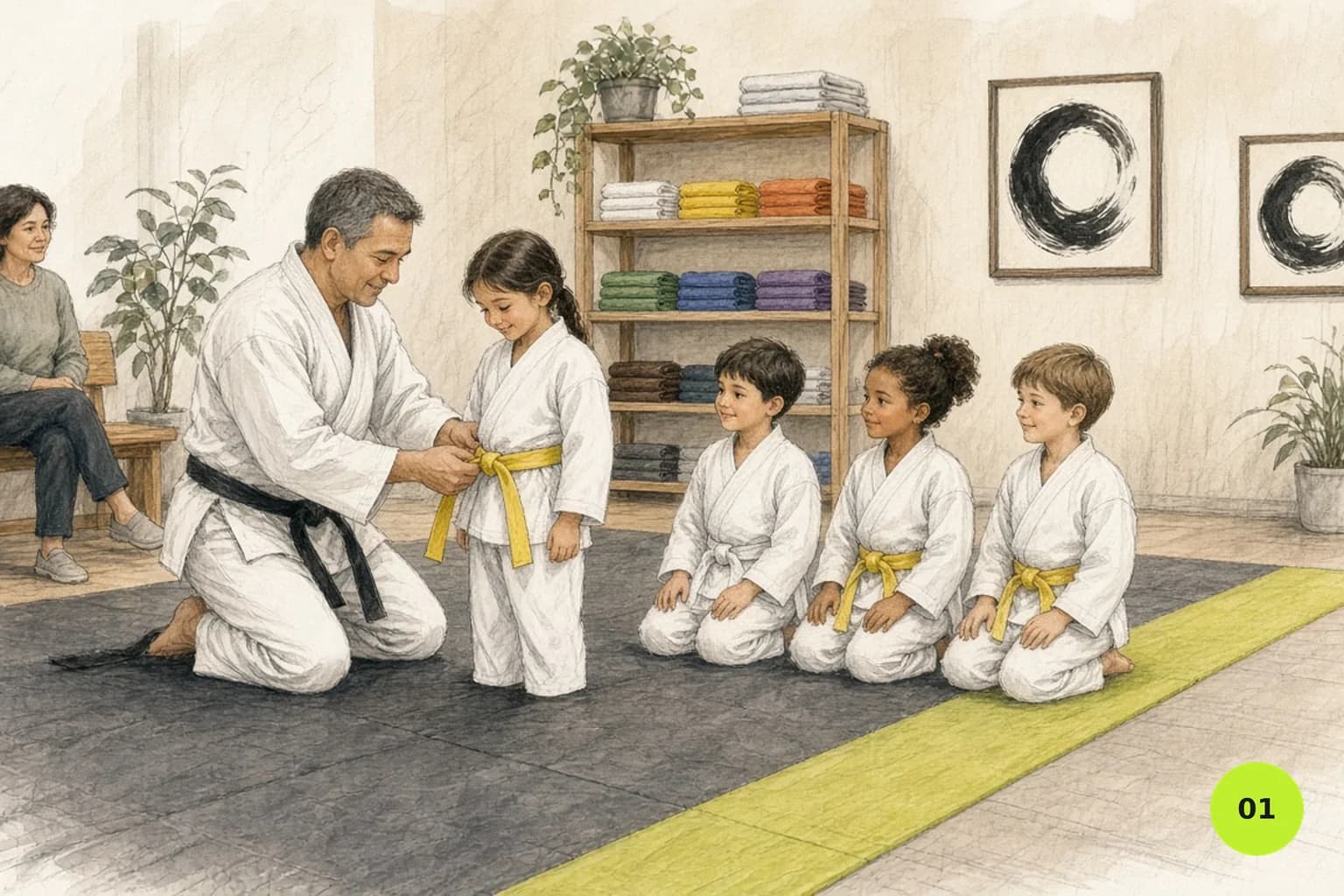
The kids BJJ belt order (ages 4 to 15)
Children don't wear blue, purple or brown. The IBJJF kids system has thirteen belts in four color groups, and each group has a minimum age:
| Group | Belts in order | Minimum age |
|---|---|---|
| White | White | Any age |
| Grey | Grey and white, grey, grey and black | 4 |
| Yellow | Yellow and white, yellow, yellow and black | 7 |
| Orange | Orange and white, orange, orange and black | 10 |
| Green | Green and white, green, green and black | 13 |
There is no minimum time at each kids belt. Instead, the IBJJF suggests three ways to split each belt into stripes:
- Every three months: three stripes, and the fourth promotion moves the child to the next belt, about a year per belt.
- Every four months: two stripes, and the third promotion moves the child to the next belt, also about a year.
- Every month: eleven stripes, and the twelfth promotion moves the child up. Stripe colors on this system vary by academy. Some use white for the first four, red for the next four and the next belt's color for the last three.
Then there's the switch at 16. In the year a teenager turns 16, they move to the adult system. A white belt may stay white. A grey, yellow or orange belt must become a blue belt. A green belt becomes blue or purple, depending on the professor's decision.
How long does it take to get a black belt in BJJ?
Add up the IBJJF minimums and you get four and a half years after earning a blue belt. White belt has no minimum, and the age limits still apply. Almost nobody moves that fast. Most adults who train a few times a week spend somewhere around eight to ten years getting from their first class to black belt, and plenty take longer.
Our BJJ belt calculator uses typical durations at three sessions a week. That works out to about two years at white, two and a half at blue, two at purple and a year and a half at brown, so roughly eight years in total. It never shows an estimate shorter than the IBJJF minimum time or age, and you can change the training frequency to see how much it moves the date.
The kyu and dan idea behind all of this came from judo. Jigoro Kano awarded the first dan ranks in 1883, according to USA Judo's history of black belt promotions. BJJ kept the black belt and ended up with far fewer colors underneath it.
For academy owners: stripes are a tracking problem
With only five adult belts, stripes do most of the motivating. And they only work if they feel fair. A student who has trained steadily for eight months and watched a newer training partner get two stripes first will notice, and some will quit over it.
Here's where academies usually slip:
- Kids stripes add up quickly. A monthly system with 40 kids means about 40 stripe decisions every month.
- The age-16 switch is easy to miss. Teenagers who turn 16 this year need moving to the adult belts, and the professor has to decide where green belts land.
- Minimum times are counted from registration. If you register students with the IBJJF, the clock starts on the day each belt is registered, not the day it was tied on.
A spreadsheet can handle this when you're small. Past a hundred students, most owners want something that counts classes for them.
We built MatSync with exactly this in mind. Your adults can follow the five-belt ladder while your kids run the grey, yellow, orange and green belts, because you set up a rank system per discipline and age group. Each belt has its color and a second color for the stripes on the bar. Give every rank a minimum number of classes and months, and attendance counts toward it. On stripe day, the progress board shows who's ready, who's close and who isn't there yet. You can also put a student on hold or schedule a promotion. Our guide to belt tracking software for martial arts clubs covers that workflow in more detail, and the BJJ curriculum planning guide covers what to teach at each level. You can also see how MatSync is set up for Brazilian jiu-jitsu academies. After a promotion, the free belt promotion certificate maker creates a printable certificate.
Quick answers about BJJ belts
What is the BJJ belt order for adults? White, blue, purple, brown, black. Black belts can then earn degrees, and the highest ranks are red and black, red and white, and red.
How many stripes are on a BJJ belt? Up to four on white, blue, purple and brown belts. A black belt has up to six degrees.
What is the highest belt in BJJ? The red belt, for 9th and 10th degree. The 10th degree was given only to the Gracie pioneers.
What is a coral belt in BJJ? The nickname for the red-and-black belt (7th degree) and the red-and-white belt (8th degree). Both are only awarded after decades at black belt.
Is there a separate no-gi belt? No. Academies use one rank for gi and no-gi training, and IBJJF no-gi divisions are split by the same belt colors even though no belt is worn.
Can a kid get a blue belt? Not under IBJJF rules. Children up to 15 use the grey, yellow, orange and green belts, and the adult blue belt starts at 16.
Do you have to compete to get a BJJ black belt? No. Promotion is the professor's decision. Competition only offers a few shortcuts in the minimum times.