Taekwondo Belt Order: ITF, WT and Poom Ranks Explained
The taekwondo belt order from white to black in both the ITF and World Taekwondo systems, what a poom belt is, how long each grade takes, and what school owners should publish.
- By
- MatSync Editorial
- Published
- October 16, 2026
- Reading time
- 8 min read
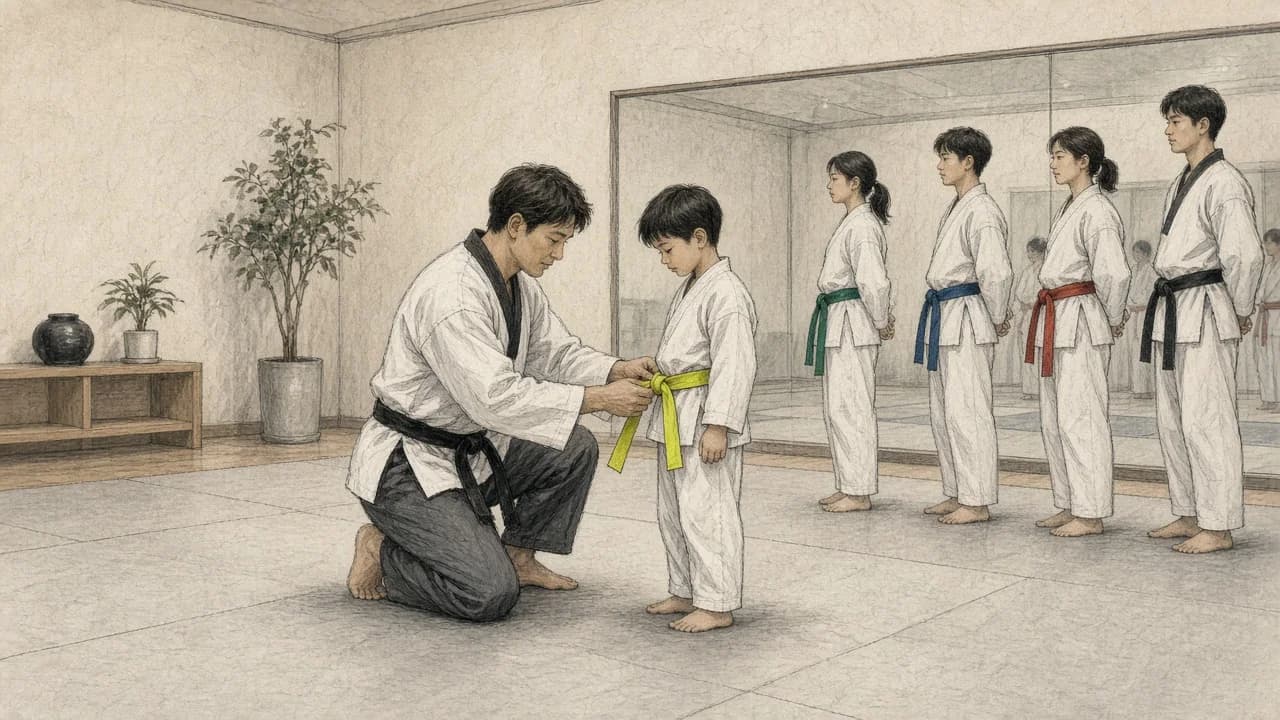
The taekwondo belt order depends on which taekwondo you train. There are two big families. Schools linked to World Taekwondo and the Kukkiwon teach the Olympic style. Schools in the International Taekwon-Do Federation (ITF) teach the style founded by General Choi Hong Hi. Both count down through ten colored-belt grades, called geup (also spelled gup or kup), and then move up through black belt dan grades. What changes between them is the colors in the middle, the junior black belt, and who signs the certificate.
Short version: white first, black last, ten grades in between. Below is the official ITF order, the usual World Taekwondo pattern, what a poom belt is, how long each stage tends to take, and what school owners should put in writing.
The ITF taekwondo belt order
The ITF is unusual because it writes its belt colors into its own rules. Its constitution lists every grade with a level name:
| Grade | Belt | ITF level |
|---|---|---|
| 10th gup | White | Beginner |
| 9th gup | White with yellow stripe | Beginner |
| 8th gup | Yellow | Novice |
| 7th gup | Yellow with green stripe | Novice |
| 6th gup | Green | Intermediate |
| 5th gup | Green with blue stripe | Intermediate |
| 4th gup | Blue | Advanced |
| 3rd gup | Blue with red stripe | Advanced |
| 2nd gup | Red | Pre-black belt |
| 1st gup | Red with black stripe | Pre-black belt |
| 1st to 3rd dan | Black | Assistant instructor (Bu Sabum) |
| 4th to 6th dan | Black | Instructor (Sabum) |
| 7th to 8th dan | Black | Master (Sahyun) |
| 9th dan | Black | Grandmaster (Sasung) |
The same rules cover a few more details. The gup stripes are sewn across the belt five centimeters from the end. Black belt rank is shown with Roman numerals embroidered on the belt, so a 3rd dan wears III. Gup certificates can come from national associations or authorized international instructors, but only ITF headquarters can issue dan certificates.
The World Taekwondo and Kukkiwon belt order
World Taekwondo runs the Olympic sport. The Kukkiwon, in Seoul, issues the black belt certificates. According to the Kukkiwon, its ranking system has two tracks: 1st to 4th poom, and 1st to 9th dan. Notice what's missing. The Kukkiwon certifies black belt ranks, not colored belts. The geup grades are run by clubs and national associations, which is why two WT schools in the same city can use different colors.
Many WT schools use the same five core colors as the ITF, often with stripes between them:
- White (10th geup)
- Yellow
- Green
- Blue
- Red
- Black (1st dan or 1st poom)
Lots of schools, especially commercial schools in the US, add extra colors such as orange, purple or brown so students get a new belt more often. Where those extra colors sit in the order changes from school to school. So if a chart puts orange after yellow and purple after green, the school chose that. The Kukkiwon didn't.
British Taekwondo, a World Taekwondo member association, describes the usual path. New students start at 10th kup on a white belt and work up to 1st kup, with gradings usually about every three months in a club.
What is a poom belt?
A poom is a junior black belt. British Taekwondo explains it simply: a black belt is called 1st dan, or 1st poom if the student is 14 or younger. In most schools, the poom belt is half red and half black, so you can spot it across the room.
A poom recognizes the same skill level as a dan, in a student who is too young for an adult dan grade. When a poom holder is old enough, the rank is normally converted to the matching dan grade. The Kukkiwon has four poom grades, so a teenager can keep progressing before converting.
A seven-year-old who earns a black belt hasn't earned the same certificate as an adult 1st dan. Explain that to families before grading day and you'll skip a lot of awkward conversations.
How long does each taekwondo belt take?
Start with your grading calendar. If your club grades every three months and you pass every test, ten geup grades take about two and a half years on paper. Real life is slower. People miss gradings, take holidays and get injured, and many instructors ask for longer gaps near red belt. Adults training two or three times a week often reach 1st dan in three to five years.
Our taekwondo belt calculator uses typical durations at three sessions a week. For a WT-style ladder that comes to about 35 months from white belt to 1st dan, and about 39 months for an ITF ladder, where the gaps near the top are a little longer. Train less often and the estimate stretches.
After black belt, the waits get much longer. British Taekwondo lists the usual minimums between dan grades:
- 1st to 2nd dan: 1 year
- 2nd to 3rd dan: 2 years
- 3rd to 4th dan: 3 years
- 4th to 5th dan: 4 years
- 5th to 6th dan: 5 years
- 6th to 7th dan: 6 years
- 7th to 8th dan: 8 years
- 8th to 9th dan: 9 years
Add those up and someone who passes every test at the first chance still needs 38 years to go from 1st dan to 9th dan. That's why 9th dan holders are rare.
What the belt colors are said to mean
Most schools teach a story for each color. White is a clean start, yellow is the soil where a seed is planted, green is the plant growing, blue is the sky it grows toward, red is a warning to control your power, and black is maturity. The exact wording changes between schools and between the ITF and WT worlds.
It's a useful way to explain progress to children. Just present it as your school's tradition rather than a universal rule, because different associations tell it differently.
For school owners: publish your belt chart
Most belt complaints in a dojang come from surprise. A parent sees a child at another school get a new belt every two months and assumes something is wrong at yours. A one-page belt policy fixes most of that. Include:
- the full belt order for each program, including stripes
- the minimum number of classes and months at each grade before testing
- what students are tested on, such as poomsae or patterns, kicks, sparring and breaking
- testing fees, if you charge them
- how juniors move from poom to dan, and which body issues black belt certificates
Then keep records that match the policy. If the rule is 24 classes and three months at green belt, someone has to know who has reached 24 classes. Easy with 20 students. Painful with 150.
MatSync keeps those records for you. Set up a rank system per discipline and age group, so your poom-track juniors and your adults each get their own ladder. Every belt gets its color, and a second color covers the stripes between yellow, green, blue and red. Put your minimum classes and months on each geup, and attendance counts toward them. Before a test, the progress board tells you who's ready, who's close and who isn't there yet, and you can put a student on hold or schedule a promotion. Our guide to belt tracking software for martial arts clubs covers that workflow in more detail. After a test, the free belt promotion certificate maker turns out a printable certificate in a minute. You can also see how MatSync is set up for taekwondo schools. If you teach more than one art, our karate belt order guide explains how the kyu and dan system compares.
Quick answers about taekwondo belts
What is the first belt in taekwondo? White, at 10th geup, in both the ITF and World Taekwondo systems.
What belt comes after yellow in taekwondo? In the ITF system, yellow with a green stripe (7th gup), then green. WT-style schools usually go from yellow to green or orange, depending on the school's chart.
What belt comes before black? Red. In the ITF it's red with a black stripe at 1st gup. Many WT schools use the same.
How many belts are there in taekwondo? The ITF has ten gup grades and nine dan grades. The Kukkiwon certifies four poom grades for juniors and nine dan grades.
Is the ITF or WT belt order correct? Both are. They're different organizations with different rules, so follow the chart your school's association uses.
Do all taekwondo schools use the same colors? No. ITF colors are fixed by its rules, but WT-style schools and independent schools, including many American schools, set their own colored belts. Ask your instructor for the written chart.