Payment Management for Martial Arts Academies
Discover how effective payment management can streamline billing operations, reduce revenue loss, and enhance member retention for martial arts schools.
- By
- RankPill
- Published
- June 18, 2026
- Reading time
- 13 min read

Running a successful martial arts academy requires more than teaching exceptional techniques and building a strong community. Behind every thriving dojo, there's a robust financial infrastructure that keeps operations running smoothly. Payment management stands as one of the most critical yet often overlooked aspects of academy operations, directly impacting cash flow, member retention, and administrative efficiency. For martial arts school owners juggling class schedules, belt promotions, and student progress, implementing an effective payment management system can mean the difference between financial stability and constant revenue challenges.
Understanding Payment Management in Martial Arts Schools
Payment management encompasses the complete lifecycle of receiving, processing, tracking, and reconciling all financial transactions within your academy. This includes monthly membership dues, registration fees, equipment purchases, private lesson payments, and special event charges. For martial arts schools, effective payment management goes beyond simply collecting money. It requires sophisticated systems that handle recurring billing, manage different membership tiers, process multiple payment methods, and maintain accurate financial records.
The complexity increases when you consider the unique challenges martial arts academies face. Students may train across multiple disciplines, families often have multiple members enrolled, and membership levels can vary from casual recreational students to competitive athletes requiring additional training. Each scenario demands flexible payment structures that traditional point-of-sale systems struggle to accommodate.
The Financial Impact of Poor Payment Management
Revenue leakage represents one of the most significant threats to martial arts academies. When payment management systems fail, the consequences extend far beyond simple accounting errors:
- Failed payment recovery delays can result in 15-25% of monthly revenue going uncollected
- Manual billing processes consume 10-15 hours per week of administrative time
- Inconsistent collection practices create awkward conversations that damage student relationships
- Lack of payment tracking leads to incomplete financial visibility and poor decision-making
- Chargeback disputes drain resources and tarnish your merchant account standing
Research from payment industry leaders shows that businesses implementing best practices for payment processing typically recover 40% more failed payments and reduce administrative overhead by up to 60%. For a mid-sized martial arts academy with 150 active members, this translates to thousands of dollars in additional annual revenue.

Key Components of Effective Payment Management
Automated Recurring Billing
Recurring billing automation forms the foundation of modern payment management for membership-based businesses. Instead of chasing down payments each month, automated systems charge members according to their predetermined schedules. This consistency benefits both academy owners and students by eliminating billing surprises and ensuring predictable cash flow.
Quality automated billing systems should support multiple payment frequencies including monthly, quarterly, semi-annual, and annual options. They must also handle mid-cycle changes such as membership upgrades, family discounts, and promotional pricing without creating billing errors. MatSync handles family pricing with a family discount at checkout for membership plans, so a second or third family member gets the right price without manual adjustments.
Multiple Payment Method Support
Modern consumers expect payment flexibility. Your payment management system should seamlessly process:
- Credit and debit cards with secure tokenization
- ACH bank transfers for lower processing fees
- Digital wallets like Apple Pay and Google Pay
- International payment methods for diverse student populations
- Point-of-sale terminals for in-person retail transactions
Each payment method carries different processing fees, settlement timeframes, and security requirements. Credit cards typically cost 2.5-3.5% per transaction but settle within 1-2 business days. ACH payments through Nacha's network cost significantly less at $0.25-0.75 per transaction but may take 3-5 business days to clear. Understanding these differences helps you optimize your payment acceptance strategy.
| Payment Method | Typical Fee | Settlement Time | Best For |
|---|---|---|---|
| Credit Card | 2.5-3.5% | 1-2 days | One-time payments, equipment sales |
| Debit Card | 1.5-2.5% | 1-2 days | Standard memberships |
| ACH/Bank Transfer | $0.25-0.75 | 3-5 days | High-value memberships, annual payments |
| Digital Wallet | 2.5-3.5% | 1-2 days | Mobile-first members, quick checkouts |
Failed Payment Recovery Systems
Failed payments represent a silent profit killer for martial arts academies. Credit cards expire, bank accounts close, and insufficient funds cause transactions to decline. Without systematic recovery processes, these failed payments often become permanent revenue losses.
Effective payment management includes automated retry logic that attempts collection at optimal times. For example, retrying a failed payment immediately often fails again, but waiting 3-5 days and retrying during typical payroll deposit periods significantly increases success rates. The system should also automatically notify members via email and SMS when payments fail, providing self-service options to update payment information.
Implementing security best practices for card-not-present transactions reduces false declines while maintaining fraud protection. This balance is crucial because legitimate payment failures frustrate members and create unnecessary administrative work.
Security and Compliance Considerations
PCI Compliance Requirements
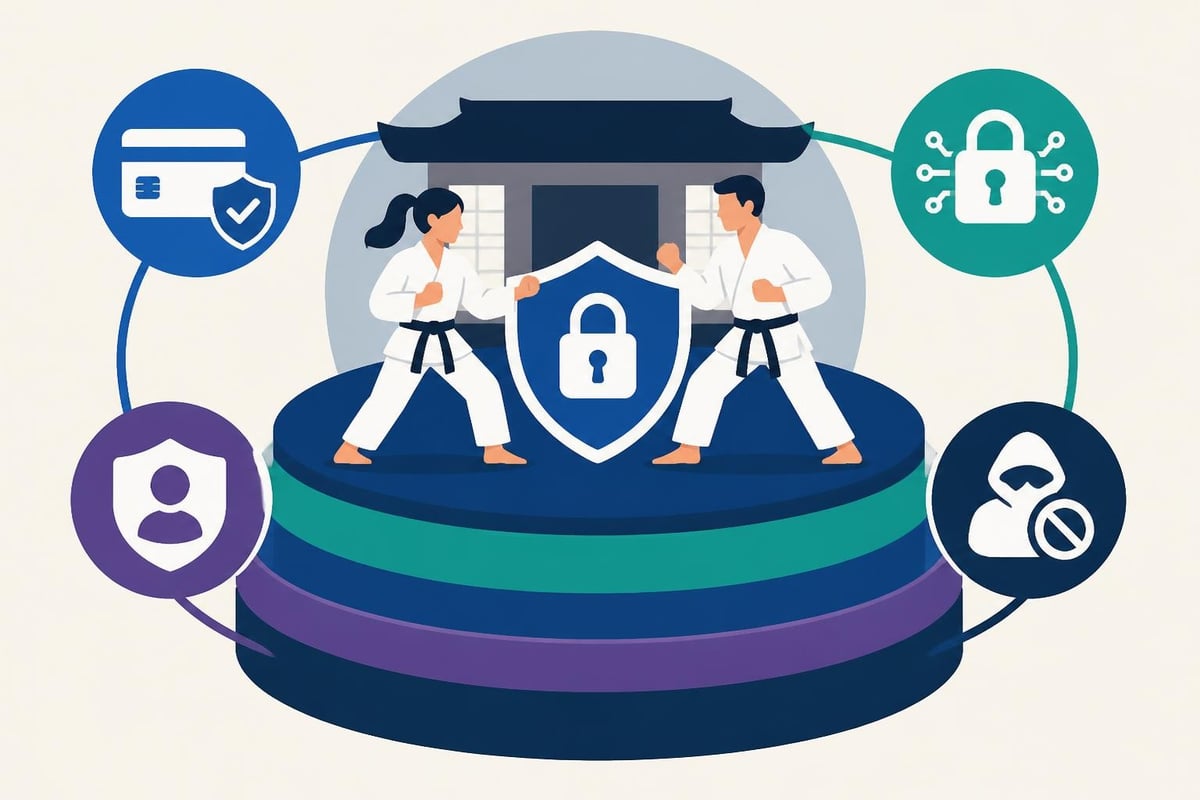
Payment Card Industry Data Security Standard (PCI DSS) compliance is non-negotiable for businesses processing credit card payments. These security standards establish requirements for protecting cardholder data throughout every transaction. Non-compliance can result in fines ranging from $5,000 to $100,000 per month, plus liability for any data breaches.
For most martial arts academies, achieving PCI compliance means partnering with payment processors and software platforms that handle the technical security requirements on your behalf. When payment information never touches your systems but instead flows directly to PCI-compliant payment gateways, your compliance burden dramatically decreases. This approach, called payment tokenization, replaces sensitive card data with secure tokens that are useless to potential hackers.
Data Protection and Privacy
Beyond PCI compliance, payment management systems must protect personal information according to various privacy regulations. This includes proper encryption of stored data, secure transmission protocols, access controls limiting who can view payment information, and audit trails documenting every payment-related action.
Academy owners should verify that their payment management platform implements:
- End-to-end encryption for all payment data transmission
- Multi-factor authentication for administrative access
- Role-based permissions restricting staff access to financial information
- Regular security audits and penetration testing
- Automatic software updates addressing newly discovered vulnerabilities
Optimizing Payment Operations for Martial Arts Schools
Streamlining Member Onboarding
First impressions matter, and the payment setup experience significantly influences new member perceptions. Complicated enrollment processes with confusing payment terms create friction that may cause prospects to reconsider their commitment. Modern payment management systems should enable seamless onboarding that can be completed in minutes, either in-person or online.
The ideal enrollment flow guides new members through selecting their training program, whether that's Brazilian Jiu-Jitsu, Muay Thai, or MMA, choosing a membership tier, entering payment information securely, and reviewing terms before finalizing. Integrated digital signature capabilities eliminate paperwork while maintaining legally binding agreements.
Managing Family and Group Accounts
Family memberships present unique payment management challenges. A single household might have three children enrolled in different programs, each with distinct belt levels, class schedules, and payment arrangements. Consolidating these into unified billing requires sophisticated account hierarchy management.
Your payment management system should support:
- Primary account holders with multiple dependents
- Customized pricing rules for family discounts
- Individual student tracking despite consolidated billing
- Flexible payment splitting between separated parents
- Automated adjustments when family members join or leave
These capabilities prevent the common scenario where family discount calculations require manual intervention each billing cycle, consuming administrative time and creating error opportunities.
Handling Payment Disputes and Chargebacks
Chargebacks occur when members dispute charges with their credit card companies rather than contacting your academy directly. Each chargeback typically costs $15-25 in processing fees plus the disputed amount, and excessive chargeback rates can jeopardize your merchant account. Implementing strong payment controls helps prevent these costly disputes.
Prevention strategies include:
- Clear billing descriptors that members recognize on their statements
- Transparent terms and conditions signed during enrollment
- Proactive communication before billing, especially for annual renewals
- Easy-to-find cancellation policies and procedures
- Detailed transaction records proving service authorization
When chargebacks do occur, comprehensive documentation from your payment management system provides the evidence needed to contest illegitimate disputes. Transaction records, signed agreements, attendance history from your attendance tracking system, and email communications create compelling chargeback responses.
Integration with Academy Operations
Connecting Payments to Student Progress
Payment management shouldn't exist in isolation from your academy's broader operations. The most powerful systems integrate financial data with student progress tracking, attendance monitoring, and program management. This integration enables insights that pure payment platforms cannot provide.
For instance, correlating payment history with attendance patterns might reveal that students who miss two consecutive weeks are 60% more likely to cancel within the next month. Armed with this intelligence, you can implement proactive retention campaigns targeting at-risk members before they decide to leave. Similarly, analyzing which belt levels have the highest retention rates helps optimize your curriculum and testing schedules.
Financial Reporting and Analytics
Comprehensive payment management platforms generate reports that transform raw transaction data into actionable business intelligence. Essential reports for martial arts academies include:
| Report Type | Key Metrics | Business Value |
|---|---|---|
| Revenue Dashboard | Monthly recurring revenue, growth rate, churn | Track overall financial health |
| Payment Method Analysis | Processing fees by method, failure rates | Optimize payment acceptance costs |
| Member Lifetime Value | Average duration, total revenue per member | Guide marketing budget allocation |
| Retention Cohort Analysis | Cancellation rates by signup month/source | Identify successful marketing channels |
| Outstanding Balance Report | Overdue accounts, aging analysis | Prioritize collection efforts |
These analytics enable data-driven decision-making that improves both financial performance and operational efficiency. For example, discovering that annual memberships have 40% better retention than monthly plans might justify offering attractive annual payment discounts.

Best Practices for Implementation
Choosing the Right Payment Management Solution
Not all payment management systems are created equal, and selecting the wrong platform can create more problems than it solves. When evaluating options, prioritize solutions built specifically for membership-based businesses or, even better, martial arts academies. Generic accounting software or basic payment processors lack the specialized features required for efficient academy management.
Essential evaluation criteria include automated recurring billing capabilities, flexible membership tier management, family account consolidation, failed payment recovery automation, comprehensive reporting and analytics, seamless integration with scheduling and attendance tracking, and responsive customer support familiar with martial arts operations.
Cloud-based platforms offer significant advantages over locally installed software, including automatic updates, access from anywhere, built-in data backups, scalability as your academy grows, and lower upfront costs through subscription pricing.
Training Staff on Payment Procedures
Even the most sophisticated payment management system requires proper staff training to deliver its full value. Your team needs to understand how to handle common scenarios like updating member payment information, processing one-time charges for equipment or special events, managing membership freezes and holds, handling refund requests according to your policies, and responding to payment-related member questions.
Developing standard operating procedures for payment-related tasks ensures consistency regardless of which staff member handles a situation. These procedures should document step-by-step processes, escalation paths for unusual situations, and communication templates for sensitive payment conversations.
Establishing Clear Payment Policies
Transparent payment policies prevent misunderstandings and protect your academy from revenue loss. Your policies should address:
- Membership payment schedules and accepted methods
- Late payment fees and grace periods
- Cancellation notice requirements and procedures
- Refund policies for various scenarios
- Freeze or hold options with associated fees
- Automatic renewal terms and opt-out processes
Make these policies easily accessible on your website, include them in enrollment agreements, and have staff reference them when addressing member questions. Clear policies reduce disputes and chargebacks while establishing professional operational standards.
Advanced Payment Management Strategies
Dynamic Pricing and Promotional Management
Strategic pricing adjustments can significantly impact revenue without requiring more students. Your payment management system should support sophisticated pricing strategies including introductory rates for new members, seasonal promotions during slow enrollment periods, loyalty discounts for long-term members, referral bonuses encouraging member recruitment, and early-bird pricing for annual membership renewals.
The key is implementing these promotions systematically through your payment management platform rather than manual spreadsheet tracking. Automated promotional management ensures discounts apply and expire correctly, preventing costly billing errors.
Cash Flow Optimization
Understanding accounts payable management best practices helps optimize the timing of your own payments to vendors, instructors, and suppliers. While accelerating member payment collection, strategically timing your outgoing payments maximizes available cash for operational needs and growth investments.
Consider structuring your billing cycles to align with major expense obligations. If rent and payroll hit on the first of each month, processing member recurring payments on the 25th-28th ensures funds are available when needed. This simple timing adjustment can prevent cash flow crunches that force expensive short-term borrowing.
Predictive Revenue Modeling
Advanced payment management platforms use historical data to forecast future revenue with remarkable accuracy. By analyzing patterns in new member acquisition, retention rates, membership tier preferences, and seasonal fluctuations, these systems project expected revenue three to twelve months into the future.
These projections inform crucial business decisions about hiring additional instructors, expanding facility space, increasing marketing budgets, or launching new programs like Karate or Kickboxing classes. Rather than guessing about financial capacity, you base expansion decisions on data-driven revenue forecasts.
Common Payment Management Mistakes to Avoid
Neglecting Failed Payment Follow-Up
The single most expensive payment management mistake is treating failed payments as inevitable losses. Many academy owners assume declined transactions represent members who intended to cancel, but data shows that 60-70% of failed payments are due to simple technical issues like expired cards or temporary insufficient funds. With proper follow-up, most of these payments can be recovered.
Automated dunning management systematically attempts collection while maintaining member relationships. The system retries payments at optimal times, sends progressively urgent notifications, provides self-service payment update options, and only flags accounts for manual intervention after automated recovery fails.
Over-Complicating Membership Structures
While flexibility in membership options can attract diverse student populations, excessive complexity creates operational nightmares. Payment management becomes nearly impossible when you offer dozens of membership combinations with inconsistent pricing logic. This complexity confuses potential members during enrollment and overwhelms staff managing billing exceptions.
Simplify your structure to three to five core membership tiers with clear value propositions. Complexity should serve strategic purposes, not accumulate through incremental policy additions over years. Periodically audit your membership options, consolidating or eliminating underutilized tiers.
Ignoring Payment Processing Costs
Payment processing fees represent a significant ongoing expense that many academy owners fail to optimize. While the differences between 2.7% and 2.9% seem trivial, these small percentages compound substantially. For an academy processing $20,000 monthly in membership dues, a 0.2% difference equals $480 annually.
Regularly review your processing rates and negotiate with providers based on your volume and transaction characteristics. Consider steering members toward lower-cost payment methods like ACH transfers through modest incentives. Even small adjustments to your payment mix can yield meaningful savings.
Effective payment management directly impacts every aspect of your martial arts academy's success, from financial stability and growth capacity to member satisfaction and operational efficiency. By implementing automated systems, maintaining security compliance, integrating financial operations with student management, and following industry best practices, you create a foundation for sustainable growth. MatSync provides martial arts academies with comprehensive payment management tools designed specifically for the unique challenges of running dojos, gyms, and training centers, automating billing processes while integrating seamlessly with attendance tracking and student progress monitoring to help you focus on what matters most: teaching exceptional martial arts.